

Homes, Trades and Games of Long Ago · Drawing 21 of 40
The voyageurs and the furs
Around 1800
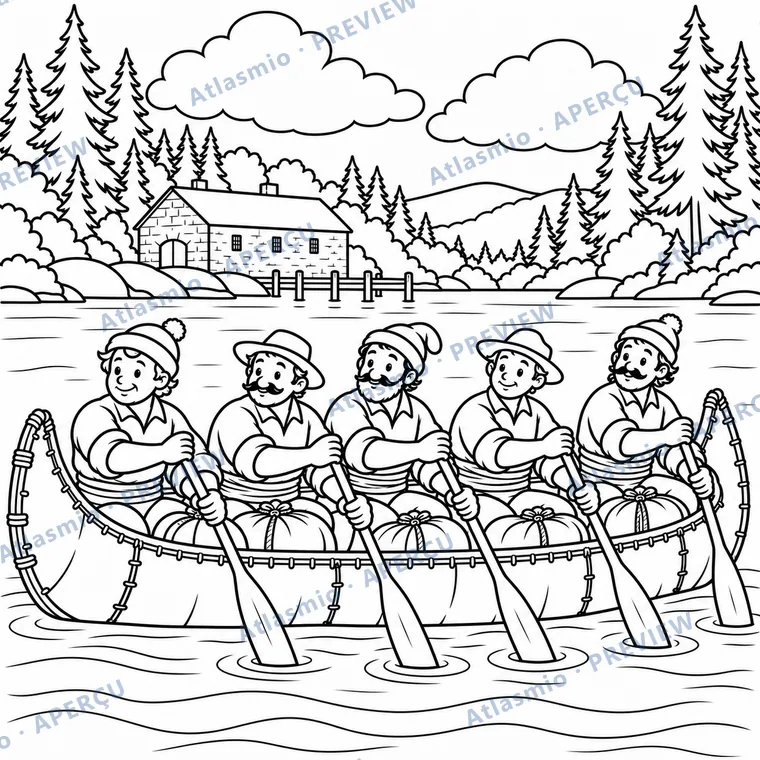
Every spring, big canoes loaded with trade goods left Lachine, near Montréal. Far to the west, the goods were traded with First Nations for beaver furs. The paddlers were called voyageurs.
Look together
How many paddles can you see?
An idea to try
Load a basket with “bundles” (cushions) and do a portage through the house, on a route with no stairs: carry the load from one room to the next without putting it down. Talk about what is heavy and what is far.
For the adult reading along
A little more to discover
Around 1800, Lachine was an important departure point for the fur trade. Voyageurs carried goods inland and brought furs back. At portages, they carried both canoes and cargo. The trade also depended on Indigenous peoples’ knowledge, work and networks.
The illustration shows a reduced crew to keep the scene readable. Count the five paddles, then imagine how the paddlers could keep the same rhythm.
Sources and illustration notes (1)
Imaginary freight canoe and voyageurs; no period painting or engraving is copied.
These links lead to other websites. Explore them with an adult. References identify the institution and the related lesson; some linked pages are in French.
- Parks Canada — The Fur Trade at Lachine National Historic Site: the voyageursCanoe brigades leaving Lachine every spring for Grand Portage, then Fort William; 40 kg packs on portages; voyageurs’ wages; North West Company.
Page prepared on September 19, 2026. Illustrations simplify places and scenes; they are not historical documents.
This drawing is from the book Life in Old Québec to Colour
Tax calculated at checkout. Terms of sale