Homes, Trades and Games of Long Ago · Drawing 20 of 40
A schooner on the St. Lawrence
The 19th century
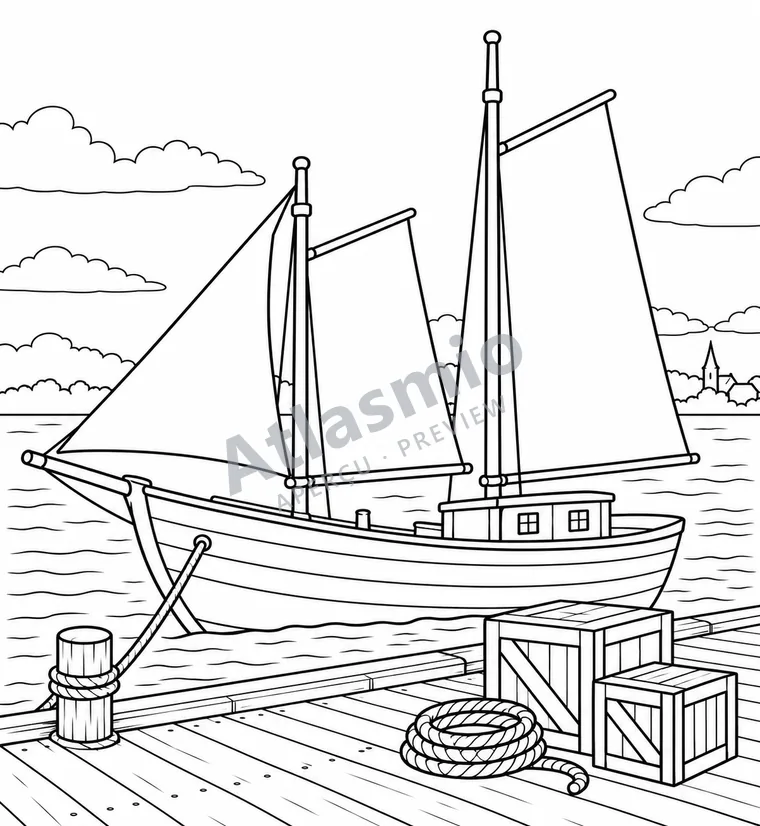
Before trucks, goods travelled by boat on the St. Lawrence. This schooner has two masts and big sails that the wind fills to push it along.
Look together
How many masts can you see?
An idea to try
Lay a sheet of paper on a table and blow gently to move it. Return to the drawing and find the part of the boat that catches the wind.
For the adult reading along
A little more to discover
Schooners carried goods between ports along the St. Lawrence. In the nineteenth century, coastal shipping helped supply villages in Charlevoix and on the Côte-Nord. The sailing schooner in the drawing has two masts, with the taller one at the back. In the twentieth century, motor schooners took over. The Saint-André, built in La Malbaie in 1956 and classified as heritage in 1978, belongs to that motorized generation: it is not the sailing vessel in our image. It is preserved at the Musée maritime de Charlevoix, on a former wintering and maintenance shipyard.
To read the drawing, start with the hull, the sails and the two masts, then the crates on the dock. Ask your child what makes the boat move. Explain that a steamboat uses an engine, while this schooner’s sails catch the wind. The schooner drawn evokes a type of ship, not a named vessel.
Sources and illustration notes (4)
An imaginary two-masted schooner with the taller mast at the back; no named ship is depicted.
These links lead to other websites. Explore them with an adult. References identify the institution and the related lesson; some linked pages are in French.
- Répertoire du patrimoine culturel du Québec — Maquette de goéletteGoélette à voiles, moyen de transport et de communication sur le Saint-Laurent au 19e siècle. La maquette est plus récente; la date du type est distinguée de celle de l’objet.
- Office québécois de la langue française — GoéletteDeux mâts, le grand mât étant à l’arrière; gréement aurique. Contrôle des hauteurs du dessin.
- Répertoire du patrimoine culturel du Québec — Bateau Le Saint-AndréCabotage et évolution des voiles vers le moteur; Saint-André construit à La Malbaie en 1956, classé le 9 octobre 1978, conservé au Musée maritime de Charlevoix.
- Musée maritime de Charlevoix — À propos du muséeAncien chantier d’hivernage et d’entretien devenu musée; distinguer ce chantier des lieux de construction des bateaux conservés.
Source review: 2026-09-19. Illustrations simplify places and scenes; they are not historical documents.