

Homes, Trades and Games of Long Ago · Drawing 31 of 40
The ice cutter
Long ago, in winter
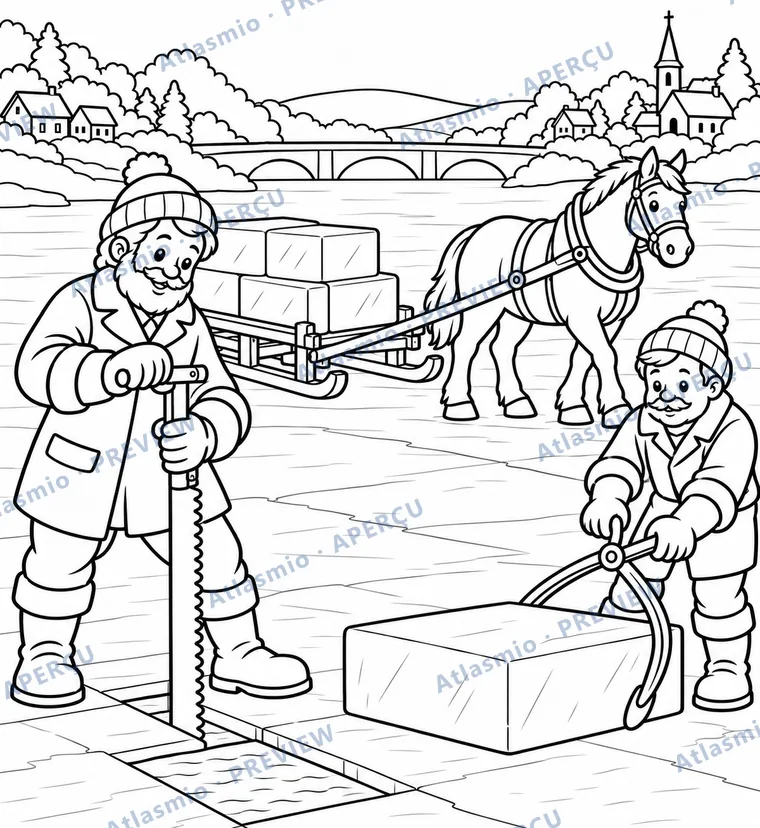
Before refrigerators, ice was fetched from the frozen river. With long saws, men cut huge blocks, and the horse hauled them to a big shed where they waited for summer.
Look together
What is used to cut the ice?
An idea to try
Put one ice cube in a bowl and another wrapped in a thick cloth. After twenty minutes, check which one melted less, and explain why the blocks were packed in sawdust.
For the adult reading along
A little more to discover
Before electric refrigerators became common, natural ice helped preserve food. In Montréal, workers sawed blocks from frozen waterways and transported them to storage buildings insulated with materials such as sawdust.
Find the saw, tongs and sled. This is a historical scene to observe, not an activity to copy on a frozen lake or river.
Sources and illustration notes (2)
Imaginary ice-harvest scene; no child on the ice.
These links lead to other websites. Explore them with an adult. References identify the institution and the related lesson; some linked pages are in French.
- Encyclopédie du MEM — Une glace bien utile (in French)Ice harvested on the St. Lawrence near the Victoria Bridge and on the Rivière des Prairies; home iceboxes; the trade disappeared in the 1950s and 1960s.
- Société d’histoire de La Prairie-de-la-Magdeleine — La coupe de la glace (in French)Blocks split off with a pick and hauled by sleigh to icehouses; the cutting method.
Page prepared on September 19, 2026. Illustrations simplify places and scenes; they are not historical documents.
This drawing is from the book Life in Old Québec to Colour
Tax calculated at checkout. Terms of sale