Homes, Trades and Games of Long Ago · Drawing 30 of 40
The kitchen icebox
Before the refrigerator
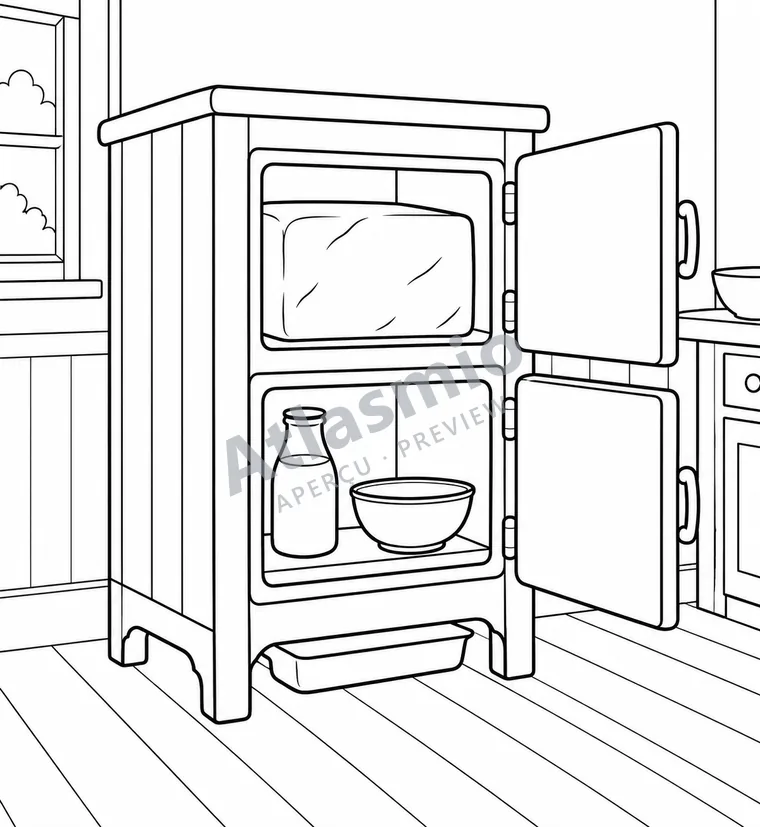
Before refrigerators, an icebox kept food cool. Its big block of ice slowly melted. Water drained into a tray, and a delivery worker brought a new block.
Look together
What needs replacing when the ice melts?
An idea to try
Watch an ice cube on a small plate for a few minutes. Your child describes the changes and connects them with the block inside the icebox.
For the adult reading along
A little more to discover
A household icebox is an insulated cabinet cooled by a block of ice. In the simplified model drawn here, the block sits at the top and meltwater is collected below. Before electric refrigerators became common, merchants harvested ice from Montréal’s frozen waterways. The MEM describes cutting in February and March, when the ice was thick: blocks were carried by sled, insulated with sawdust in storage buildings, then sold to homes and businesses. This trade declined in the 1950s and 1960s as refrigerators became more widely available.
The drawing focuses on the kitchen icebox. With your child, tell apart the cabinet, the food, the block and the little tray at the bottom. Ask what happens to the ice as it melts and why it has to be replaced.
Sources and illustration notes (2)
An interpreted kitchen icebox showing a cooling principle, without reproducing a particular model.
These links lead to other websites. Explore them with an adult. References identify the institution and the related lesson; some linked pages are in French.
- Collections Marguerite-Bourgeoys — Pince à glaceAvant la généralisation du réfrigérateur au milieu du 20e siècle, utilisation de blocs de glace pour conserver les aliments.
- Encyclopédie du MEM — Une glace bien utileRécolte de glace sur le Saint-Laurent et la rivière des Prairies; glacières domestiques; disparition du métier dans les années 1950-1960.
Source review: 2026-09-19. Illustrations simplify places and scenes; they are not historical documents.