Homes, Trades and Games of Long Ago · Drawing 27 of 40
The wood-burning cookstove
The early 20th century
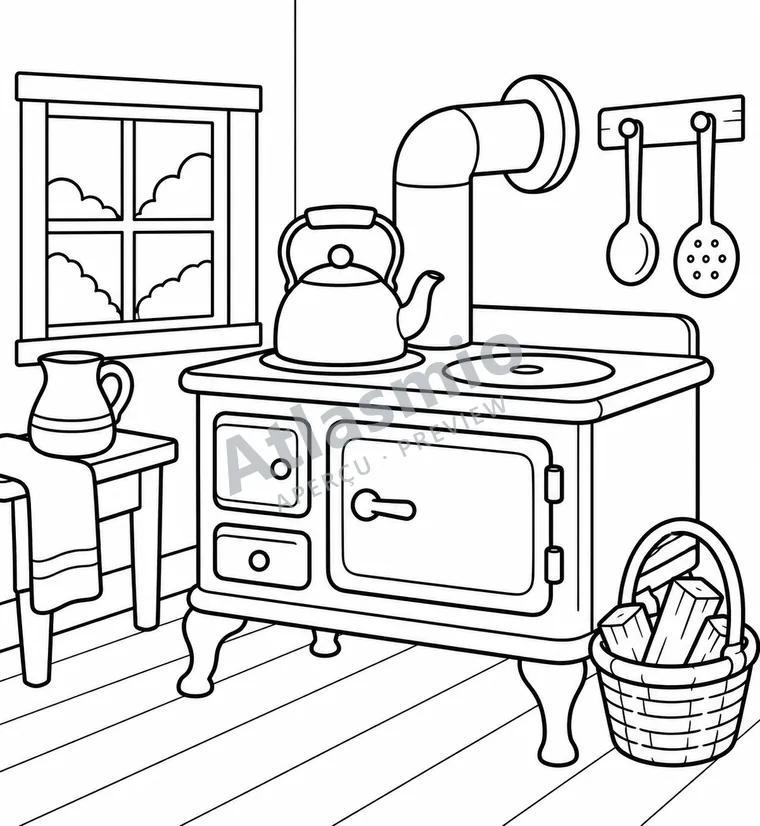
Before electric stoves, meals were cooked on a wood stove. The fire burns behind the little door, and the kettle heats on top. The pipe carries the smoke outside.
Look together
Where can you see the kettle?
An idea to try
Find the kettle in the drawing, then draw something used today to heat water. Compare their shapes and handles.
For the adult reading along
A little more to discover
A wood cookstove heated the house and cooked the meals at the same time: the fire burns behind the little door, the top plates hold the kettle and the pots, the oven bakes the bread and the pipe carries off the smoke. Amable Bélanger founded his foundry in 1867 and moved it to Montmagny in 1872, near the railway; the company made wood stoves and later diversified its production. The guide of the Société des musées du Québec describes a similar range, made between 1900 and 1925, kept at the Musée régional de Kamouraska.
In the picture, the firebox and the cooking surface occupy separate places. The kettle lets your child spot a familiar object. Compare with a kitchen today, staying with what can be seen: the scene is simplified and carries no brand.
Sources and illustration notes (2)
An imaginary, unbranded stove and kitchen; this is not a guide to using an old appliance.
These links lead to other websites. Explore them with an adult. References identify the institution and the related lesson; some linked pages are in French.
- Société des musées du Québec — Guide Info-Muse, cuisinière à bois (fiche exemple)Cuisinière à bois conservée au Musée régional de Kamouraska, produite vers 1900–1925, pour préparer la nourriture et la conserver au chaud. Dessin sans marque.
- Répertoire du patrimoine culturel du Québec — Fonderie Amable BélangerFonderie fondée en 1867 et installée à Montmagny en 1872; production de poêles à bois puis diversification. La notice n’établit pas une fin de production des modèles à bois en 1967.
Source review: 2026-09-15. Illustrations simplify places and scenes; they are not historical documents.