Homes, Trades and Games of Long Ago · Drawing 26 of 40
At the general store
Around 1900
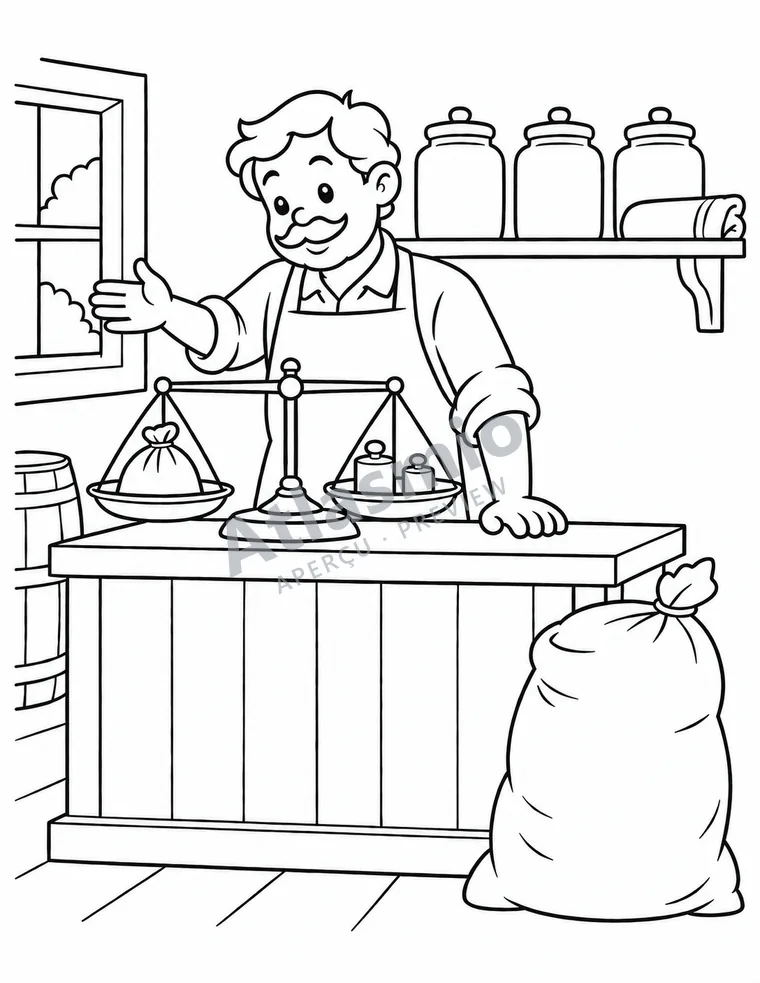
In the village, the general store sells almost everything: flour, sugar, nails, boots. The storekeeper uses his balance to weigh a bag of goods.
Look together
How does the storekeeper know how much the bag weighs?
An idea to try
Set up a pretend shop with four unbreakable objects. Your child explains what they would choose to make a meal or do a task at home.
For the adult reading along
A little more to discover
In the nineteenth century, general stores offered varied goods: food, clothing and hardware. Customers could buy, barter or use credit. These stores were also meeting places. Mail-order catalogues and improvements in transport and communication changed their role. In Maskinongé, the Magasin général Le Brun brings together three buildings from different periods, preserving the memory of this trade. It also housed a post office.
The word “general” invites a hunt for the variety of things gathered here. With your child, sort what is eaten from what serves the house, and ask how the storekeeper knows what the bag weighs. This is an imaginary store, not an inventory valid for every village. On the balance, the bag rests in one pan and known weights in the other. When the two sides balance, the bag’s mass can be compared with the weights.
Sources and illustration notes (3)
An imaginary store and shopkeeper; the goods are not an inventory of a documented business.
These links lead to other websites. Explore them with an adult. References identify the institution and the related lesson; some linked pages are in French.
- Répertoire du patrimoine culturel du Québec — Ancien magasin général Norbert-DionneMarchandises variées, vente, échange, crédit et rôle social; transformations liées aux transports et aux catalogues.
- Répertoire du patrimoine culturel du Québec — Magasin général Le BrunEnsemble de trois bâtiments à Maskinongé, rôle commercial et bureau de poste. Les dates divergentes de construction du grand magasin ne sont pas retenues.
- Magasin général Le Brun — Histoire et muséeHistoire des trois magasins et fonction de bureau de poste; la date du grand magasin diffère de celle donnée dans la notice patrimoniale.
Source review: 2026-09-19. Illustrations simplify places and scenes; they are not historical documents.