Homes, Trades and Games of Long Ago · Drawing 03 of 40
A birchbark canoe
A skill passed down
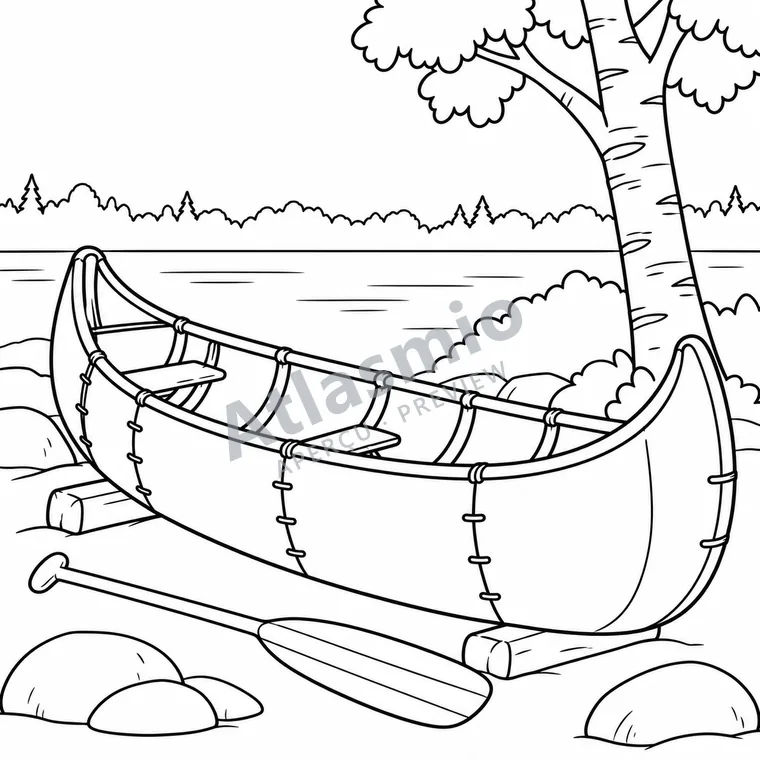
Birchbark sheets are sewn together with roots over a wooden frame. The canoe is light and floats well. At Manawan, Atikamekw builders pass this skill to younger people.
Look together
Can you see the tree whose bark makes the canoe?
An idea to try
Find two household objects made from different materials. Your child chooses one and explains who taught them to use it. Share an example of your own.
For the adult reading along
A little more to discover
A bark canoe is made from what the forest gives: big sheets of birchbark, cedar ribs, spruce roots for sewing and spruce gum to seal the seams. Light enough to carry on the shoulders from one portage to the next. The National Film Board’s César’s Bark Canoe, dated 1971, shows César Newashish of Manawan, aged 67, building a canoe this way. Without narration, the film runs almost an hour. The Musée de la civilisation keeps a canoe he made around 1966.
The Atikamekw Nation has three communities, Manawan, Wemotaci and Opitciwan, on its ancestral territory, Nitaskinan, which includes the Saint-Maurice watershed and extends beyond it. The Atikamekw language is spoken by the great majority of residents. With your child, talk about the people who show us how to make something: that is how this knowledge carries on.
Sources and illustration notes (6)
An original canoe inspired by birchbark construction; it does not copy César Newashish’s canoe or particular cultural designs.
These links lead to other websites. Explore them with an adult. References identify the institution and the related lesson; some linked pages are in French.
- Communauté de Manawan — ArtisanatArtisanat atikamekw de Manawan, notamment canots d’écorce de bouleau, et continuité des savoir-faire.
- Musée de la civilisation — CanotCanot atikamekw de Manawan, fabriqué par César Newashish vers 1966; matériaux et fonction. Le dessin ne reproduit pas cet objet.
- ONF — César et son canot d’écorce (1971)Film de Bernard Gosselin : César Newashish, 67 ans, construit un canot avec écorce de bouleau, cèdre, racines et gomme d’épinette.
- Gouvernement du Québec — Profil de la nation atikamekwTrois communautés : Manawan, Wemotaci, Opitciwan; vitalité de la langue atikamekw.
- Conseil de la Nation Atikamekw — Plan stratégique, NitaskinanPage 7 : territoire comprenant le bassin du Saint-Maurice et des portions de bassins voisins; trois communautés.
- ONF — César’s Bark CanoeCésar Newashish âgé de 67 ans; écorce de bouleau, cèdre, racines et gomme d’épinette; film sans commentaire.
Source review: 2026-09-15. Illustrations simplify places and scenes; they are not historical documents.