

Homes, Trades and Games of Long Ago · Drawing 04 of 40
The Inuit qajaq
A skill passed down
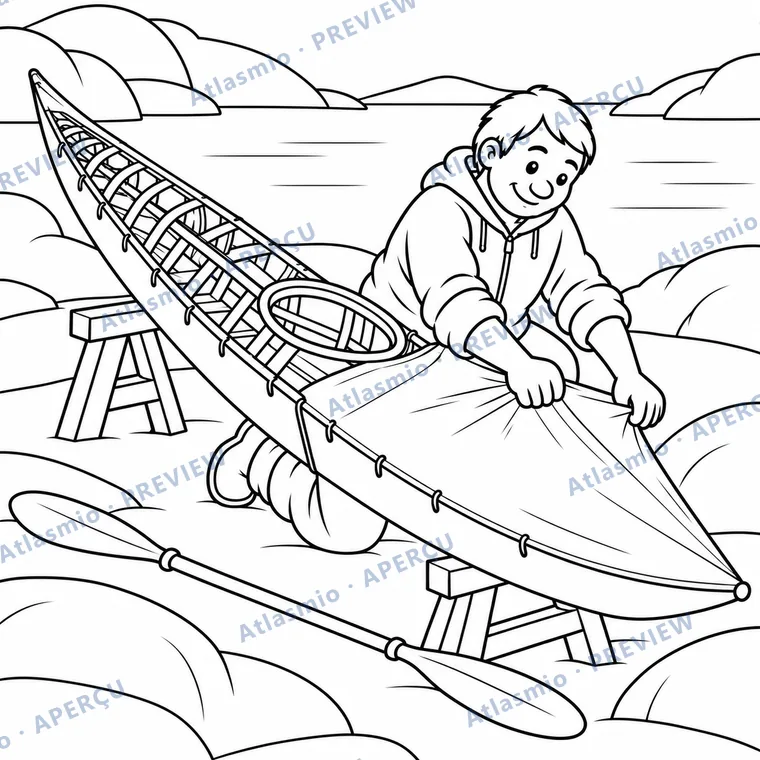
The qajaq, or kayak, comes from the Inuit and other Arctic peoples. Sealskins stretched over a wooden frame make a light, fast boat. In Nunavik, people still learn to build them.
Look together
Where can you still see the qajaq’s frame?
An idea to try
Shape a small boat frame from pipe cleaners; an adult folds in any sharp ends. Stretch a piece of cloth over it and tie it on with string: the “skin” stays on the frame without glue.
For the adult reading along
A little more to discover
In Nunavik, Kativik Ilisarniliriniq projects pass on qajaq-building skills today. Traditional boats combined a frame, often of wood, with a sealskin covering. This work transmits Inuit expertise rather than simply preserving an old object.
Contemporary workshops may use fabric instead of skins. The illustration evokes an outdoor workshop. Find the exposed frame and the paddle; the scene is not a photograph of a particular workshop.
Sources and illustration notes (3)
An imaginary Inuit builder assembles a qajaq in Nunavik. The scene evokes knowledge still being passed on.
These links lead to other websites. Explore them with an adult. References identify the institution and the related lesson; some linked pages are in French.
- Kativik — Reclaiming the qajaqBuilding qajait in Nunavik: seal skins stretched over a frame of driftwood and bone; passing the skill on to young people.
- Avataq Cultural Institute — Local cultural committeesActivities building sealskin tents, umiaq and kayaks in Nunavik communities.
- Répertoire du patrimoine culturel du Québec — Pièce de kayak (in French)A preserved kayak part; an Inuit boat.
Page prepared on September 19, 2026. Illustrations simplify places and scenes; they are not historical documents.

This drawing is from the book Life in Old Québec to Colour
Tax calculated at checkout. Terms of sale