

Provinces and Territories · Drawing 39 of 42
Two voices face to face
Nunavut
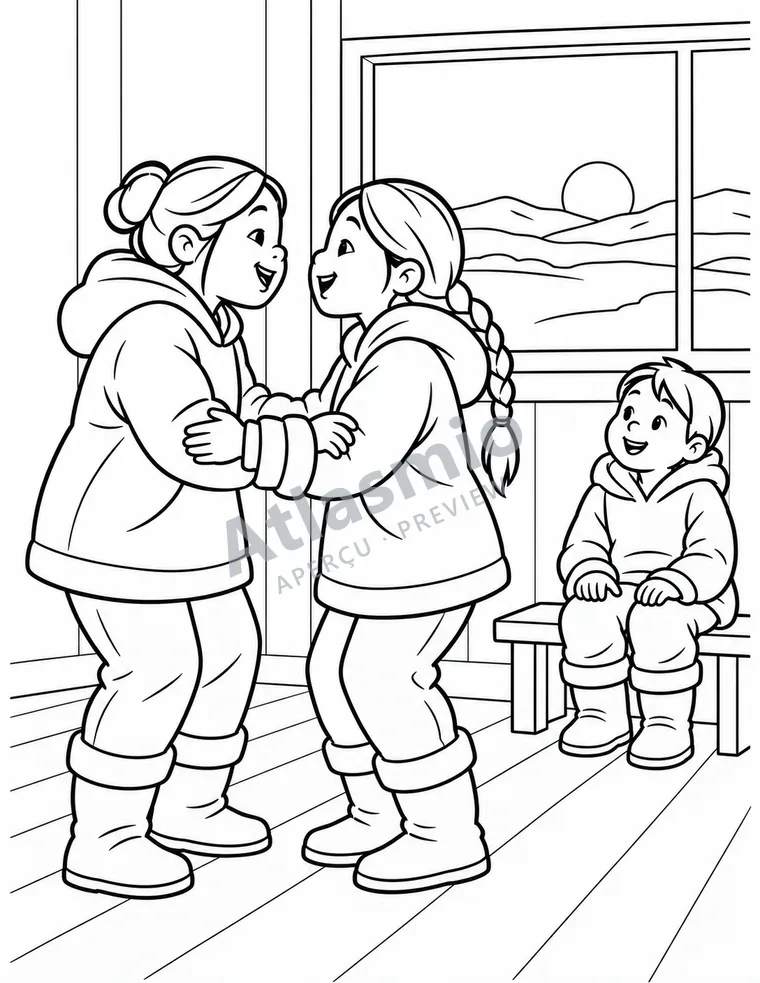
In Nunavut, Inuit throat singing is a game for two singers standing face to face. The first to laugh or run out of breath loses!
Look together
Which animal sound could you make with your voice?
An idea to try
Listen together to a recording of throat singing by Inuit performers, then name the sounds you think you hear.
For the adult reading along
A little more to discover
The Indigenous Peoples Atlas of Canada, created with Inuit Tapiriit Kanatami, describes throat singing, katajjaq in Inuktut, as a traditional competitive game, usually between two women standing face to face. Their voices overlap in short repeated patterns, often imitating geese, caribou or other sounds, until one runs out of breath, stumbles or starts to laugh. The word katajjaq is used in some regions; elsewhere, Inuit vocal games have other names.
Christian missionaries once banned these games, and a revival began in the 1980s among Elders and youth. In ITK’s magazine, an Inuk performer from Iqaluit writes that throat singing and drum songs helped her learn more Inuktitut and strengthen her identity. Listen to Inuit performers with your child rather than imitating the technique.
Sources and context (3)
These links lead to other websites. Explore them with an adult. Source titles appear in their original language; some linked pages are in French.
- Indigenous Peoples Atlas of Canada — Performing ArtsKatajjaq in Inuktut, throat singing in English; a traditional competitive game, usually between two women face to face; brief staggered motifs imitating geese or caribou; ends when one runs out of breath, stumbles or laughs.
- The Canadian Encyclopedia — Inuit Vocal GamesThe term katajjaq applies to some regions only; banned by Christian missionaries; resurgence in the 1980s among Elders and youth; two women face to face, game ends when one runs out of breath or laughs.
- Inuit Tapiriit Kanatami — Live by the DrumAn Inuk performer from Iqaluit: throat singing, drum dancing and drum songs help her learn more Inuktitut and strengthen her Inuk identity.
Source review: 2026-09-24. Illustrations simplify places and scenes; they are not historical documents.