

Provinces and Territories · Drawing 40 of 42
The narwhal, unicorn of the sea
Nunavut
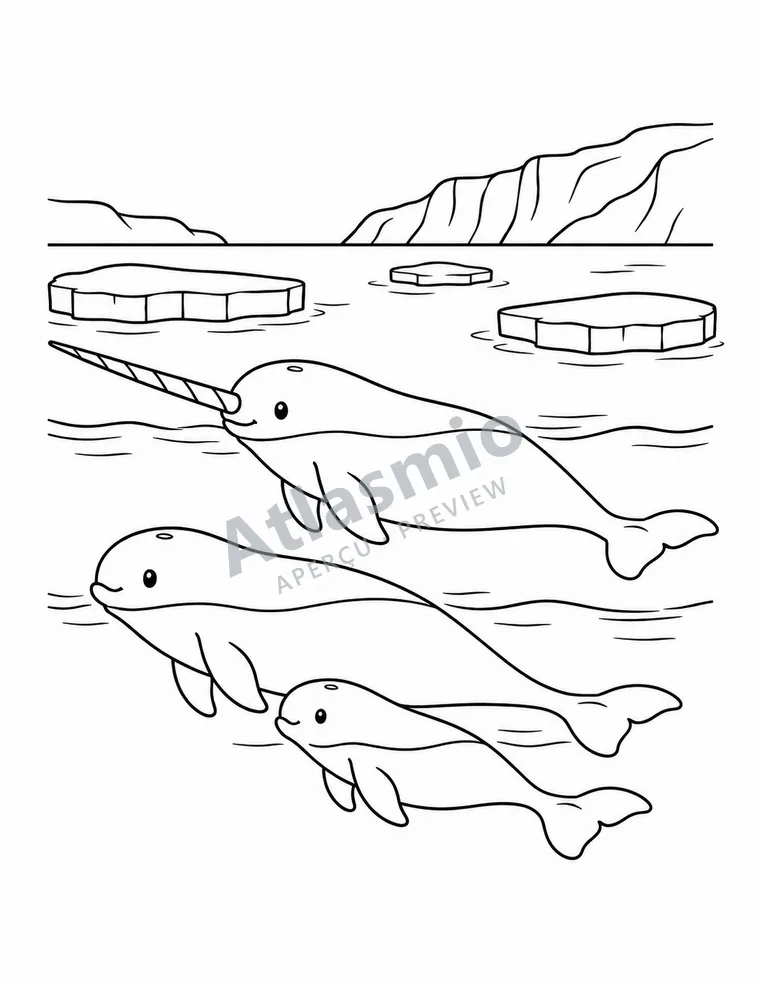
In Nunavut’s waters, narwhals often swim in small groups. The male’s long tusk looks like a unicorn’s horn, but it is really a tooth!
Look together
How many narwhals have a tusk?
An idea to try
Use a piece of string or your footsteps to measure 3 metres: a narwhal’s tusk can grow that long!
For the adult reading along
A little more to discover
The narwhal is a toothed whale of the Arctic. Its tusk is a long spiral tooth growing from the upper jaw: it can reach 3 m and usually grows only on males, although a few females have short tusks. Narwhals have no dorsal fin, and they have not been observed breaking sea ice with their tusks. Parks Canada says Tallurutiup Imanga (Lancaster Sound), in Nunavut, provides essential habitat for up to 75% of the world’s narwhals.
In 2019, the Qikiqtani Inuit Association and the Government of Canada signed an agreement for this national marine conservation area. Inuit have observed narwhals for centuries, and Elders and scientists now share their knowledge. A quotation on Parks Canada’s page puts it this way: “the ocean is like a forest to us.” Marvel at the narwhal with your child, remembering that the sea also feeds people.
Sources and context (3)
These links lead to other websites. Explore them with an adult. Source titles appear in their original language; some linked pages are in French.
- Hinterland Who’s Who — NarwhalTusk: a long spiral tooth from the upper jaw, up to 3 m, usually on males; no dorsal fin; not observed breaking sea ice with the tusk; small groups; Inuit Elders and scientists sharing knowledge; “Unicorn of the Sea”.
- Parks Canada — Tallurutiup Imanga: ecological valuesEssential habitat for narwhal (up to 75% of the global population); quotation: “the ocean is like a forest to us”.
- Qikiqtani Inuit Association — Parks and Conservation AreasTallurutiup Imanga formally established in August 2019 through an Inuit Impact and Benefit Agreement between QIA and the Government of Canada; it has sustained Inuit for generations.
Source review: 2026-09-24. Illustrations simplify places and scenes; they are not historical documents.