

Provinces and Territories · Drawing 04 of 42
Houses with grassy roofs
Newfoundland and Labrador — around the year 1000
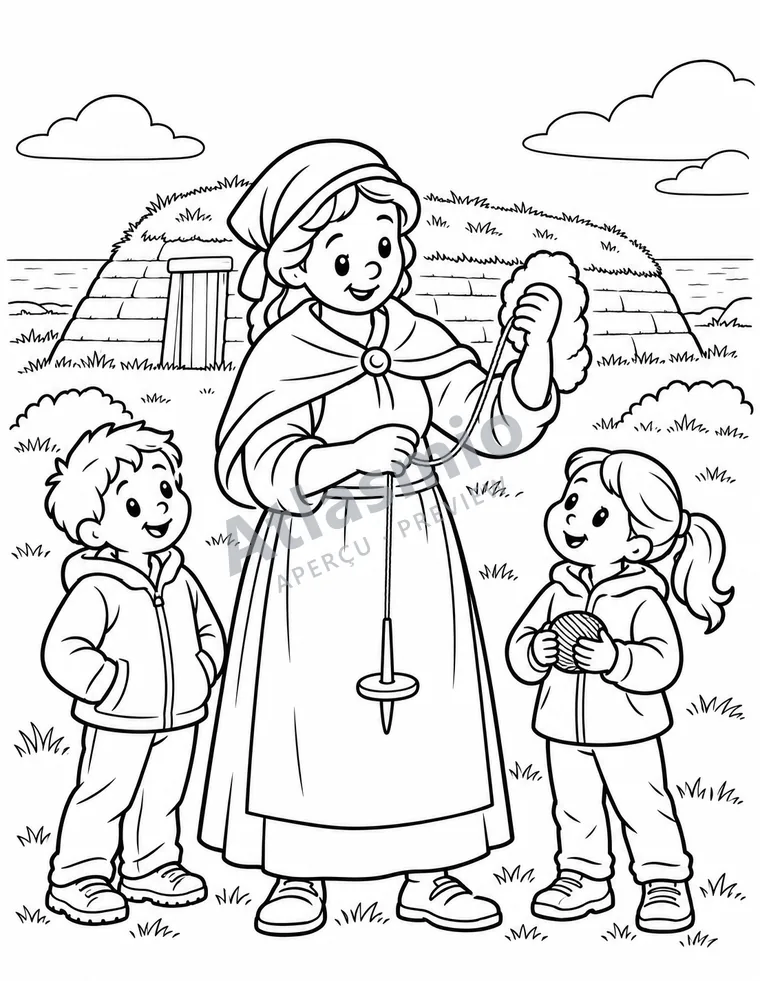
About 1,000 years ago, Norse travellers from Greenland built sod houses at L’Anse aux Meadows. Today, guides in costume show how they lived.
Look together
Would you like to sleep in a sod house? Why?
An idea to try
Gently stretch a cotton ball while twisting it between your fingers: your child sees a thread appear, as with a spindle.
For the adult reading along
A little more to discover
At the tip of Newfoundland’s Great Northern Peninsula, L’Anse aux Meadows preserves the remains of a Norse encampment more than 1,000 years old. Excavations uncovered eight 11th-century buildings with sod walls and roofs over a timber frame. Iron slag, boat rivets and a small spindle whorl, a spinning tool used by women, were also found. The site has been on the UNESCO World Heritage List since 1978.
The Norse were only one of the groups who lived here: Parks Canada notes that Indigenous peoples used the site for thousands of years before them, so it is best not to speak of a “discovery.” Today’s buildings are reconstructions, and the costumed guides play characters. Compare this house with your child’s own home: walls, roof, keeping warm.
Sources and context (3)
These links lead to other websites. Explore them with an adult. Source titles appear in their original language; some linked pages are in French.
- Parks Canada — L’Anse aux Meadows National Historic SiteAt the tip of Newfoundland’s Great Northern Peninsula; Norse expeditions from Greenland built a timber-and-sod encampment over 1,000 years ago; costumed Viking interpreters; UNESCO World Heritage Site in 1978.
- Parks Canada — L’Anse aux Meadows: Culture and historyEight 11th-century Norse buildings with sod walls and roofs on a frame; iron slag; iron boat nails or rivets; a small spindle whorl; spindle whorls and knitting needles were tools used by women.
- Parks Canada — Indigenous Sites (L’Anse aux Meadows)Indigenous peoples used the site as far back as 6,000 years ago; five or six distinct groups identified, including Dorset camps more than 200 years before the Norse.
Source review: 2026-09-24. Illustrations simplify places and scenes; they are not historical documents.