

Canadian history · Drawing 03 of 37
Inuit ancestors on the move
Around 1200
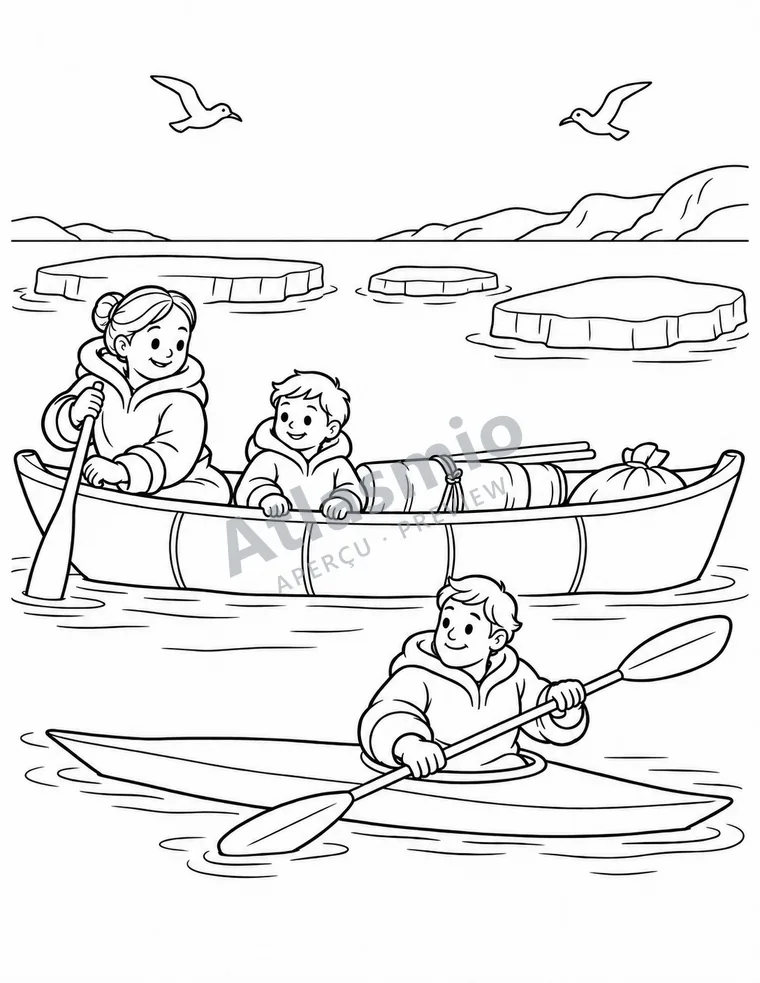
Around 1200, Inuit ancestors from Alaska were travelling east across the Arctic by umiaq, a big skin boat. Today, most Inuit in Canada live in Inuit Nunangat, their homeland.
Look together
Would you like to travel in an umiaq, and why?
An idea to try
On a map or globe, find Alaska and Greenland, then trace with your finger the long way east across the Arctic. Then look for Nunavut, where many Inuit live today.
For the adult reading along
A little more to discover
Archaeologists call these Inuit ancestors the Thule, after a place in northern Greenland; The Canadian Encyclopedia now says “early Inuit,” and some Inuit Elders speak of the Taissumanialungmiut, “the people of a very long time ago.” According to the Encyclopedia, groups from northern Alaska moved into the Eastern Arctic around 1200, some reached Greenland within about a century, and by the 1400s they lived throughout the Eastern Arctic. They travelled by dog sled, by qajaq and by umiaq, a large family boat covered with hides that carried people and their camps.
The Arctic was already home to earlier peoples, whom archaeologists call Pre-Dorset and Dorset. Writing in the Indigenous Peoples Atlas of Canada, Inuit describe 5,000 years of their history in the Arctic, with oral histories that reach back to time immemorial. Today, most Inuit in Canada live in the four regions of Inuit Nunangat. Talk with your child about long family journeys, then and now: this is the history of families who still live in the Arctic.
Sources and context (3)
These links lead to other websites. Explore them with an adult. Source titles appear in their original language; some linked pages are in French.
- The Canadian Encyclopedia — Early Inuit (Thule Culture)Article by Patrick Jolicoeur, last edited February 27, 2025: early Inuit groups from northern Alaska moved into the Eastern Arctic (Canada and Greenland) around 800 years ago (ca. 1200 CE); in roughly a century some crossed what is now the Northwest Territories and Nunavut to Greenland; by roughly the 15th century they lived throughout the Eastern Arctic; direct ancestors of Inuit today, distinct from the Dorset and Pre-Dorset; the name “Thule” comes from a community in northern Greenland and the article prefers “early Inuit”; some Inuit Elders say Taissumanialungmiut, “the people of a very long time ago”; dogsleds, umiak and kayak.
- Indigenous Peoples Atlas of Canada (Inuit section) — WildlifeWritten in the Inuit voice (the Atlas was created by the Royal Canadian Geographical Society with Inuit Tapiriit Kanatami): walrus hides covered the frames of large family boats (umiaq) used for transporting people and their camps; sealskins were also made into boats and kayaks; sealskin parkas and trousers are still worn in spring and summer.
- Indigenous Peoples Atlas of Canada (Inuit section) — Inuit NunangatWritten in the Inuit voice: 5,000 years of Inuit history in the Arctic; oral histories that stretch back to time immemorial; four regions make up Inuit Nunangat (Inuvialuit Settlement Region, Nunavut, Nunavik, Nunatsiavut); the majority of Inuit in Canada live there; Inuit co-manage their homelands under land claims agreements.
Source review: 2026-09-24. Illustrations simplify places and scenes; they are not historical documents.