

Canadian history · Drawing 02 of 37
Norse sailors in Newfoundland
Around the year 1000
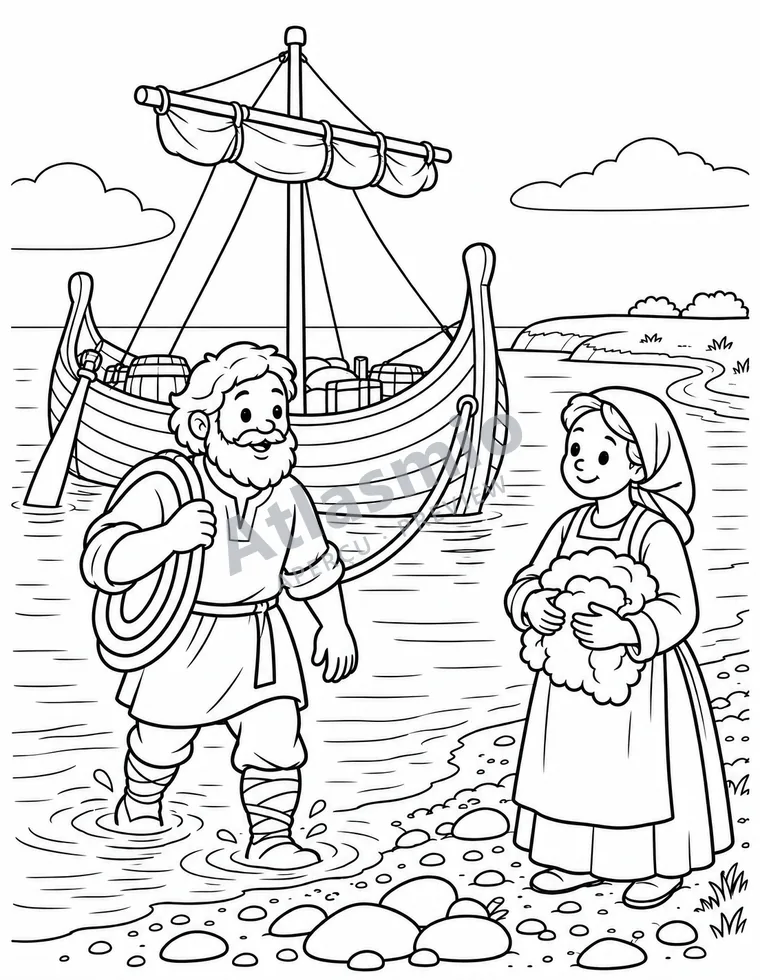
Around the year 1000, Norse sailors from Greenland landed at L’Anse aux Meadows, in Newfoundland, and stayed only a short time. Indigenous peoples had used this place for thousands of years.
Look together
What would you bring on a long sea voyage?
An idea to try
Fold a paper boat together and give it one square paper sail. Float it in the sink with your child and count how many small objects it can carry.
For the adult reading along
A little more to discover
At the tip of Newfoundland’s Great Northern Peninsula, archaeologists uncovered an 11th-century Norse base: eight buildings of sod over wooden frames, iron slag and nails from boat repair. The buildings could house 70 to 90 people, mostly men with a few women. The Norse used the camp for only about a decade, as a base to explore farther south. It is the oldest known European settlement in the Americas and has been a UNESCO World Heritage Site since 1978.
The land was not empty. Indigenous peoples had used the site for thousands of years, as far back as about 6,000 years ago, including the Dorset more than 200 years before the Norse, though no one seems to have camped there during the Norse stay. The sagas tell of meetings and clashes with local peoples, probably ancestors of the Mi’kmaq, Beothuk and Innu. With your child, avoid saying that the Norse “discovered” America.
Sources and context (3)
These links lead to other websites. Explore them with an adult. Source titles appear in their original language; some linked pages are in French.
- Parks Canada — L’Anse aux Meadows National Historic Site: Indigenous SitesIndigenous peoples used the site as far back as 6,000 years ago; five or six groups; Dorset camps more than 200 years before the Norse; none there during the Viking explorations; clashes elsewhere in Vinland.
- Parks Canada — L’Anse aux Meadows National Historic Site: Culture and historyEight 11th-century Norse buildings with sod walls and roofs over a frame; oldest known European settlement of the New World; iron slag and boat nails; tools showing that women were present.
- The Canadian Encyclopedia — L’Anse aux Meadows11th-century Norse outpost; buildings could house 70 to 90 people, mostly men; occupation only about a decade; base for exploring farther south; saga encounters probably with ancestors of the Mi’kmaq, Beothuk and Innu; UNESCO World Heritage Site in 1978.
Source review: 2026-09-24. Illustrations simplify places and scenes; they are not historical documents.