

Canadian history · Drawing 04 of 37
From kanata to Canada
1535
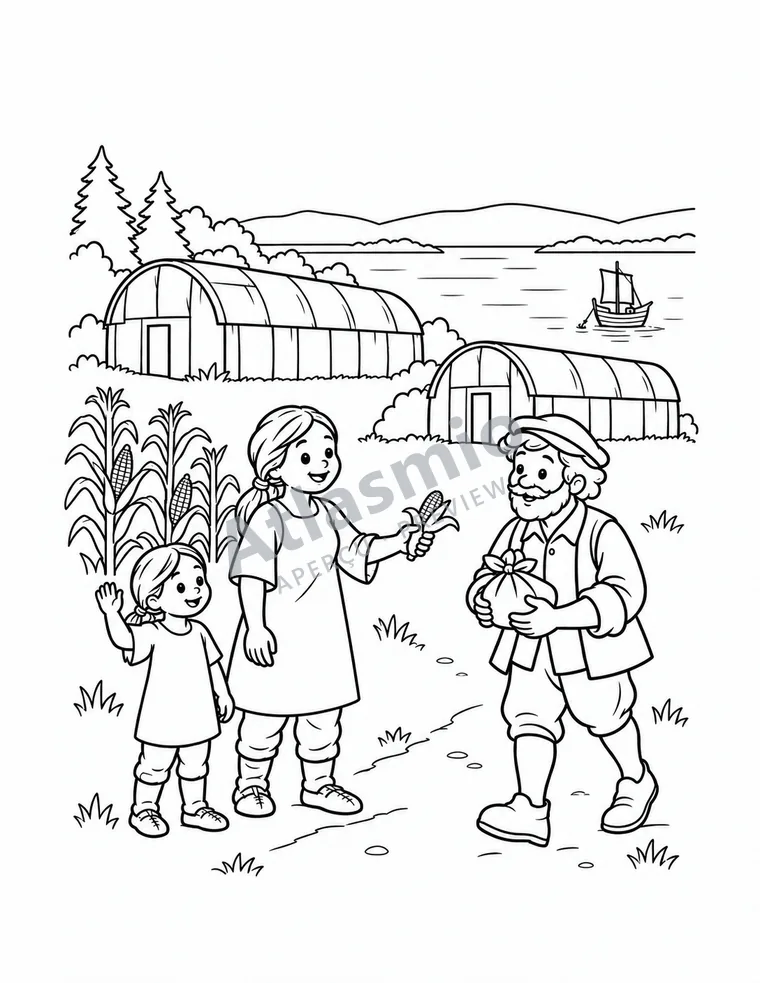
In 1535, two young men of Stadacona, back from France, led Jacques Cartier to their village, where Québec City stands today. Their word for village, kanata, probably gave Canada its name.
Look together
How many longhouses can you count in the village?
An idea to try
Say the name of your town or street together and try to find out where it comes from. Ask your child what name they would give a new village, and why.
For the adult reading along
A little more to discover
In 1534, at Gaspé, Jacques Cartier took Domagaya and Taignoagny, two sons of Donnacona, the chief of Stadacona, to France to train them as interpreters. On September 7, 1535, they came home with him, and Parks Canada notes that the meeting was a cause for many celebrations. According to Canadian Heritage, the name Canada likely comes from kanata, “village” or “settlement,” the word the young men used for Stadacona; Cartier then used it for the whole area under Donnacona.
The story has a painful side. In May 1536, Cartier seized Donnacona, his two sons and two other men, and sailed for France with ten people from the region, including four children. According to the Dictionary of Canadian Biography, nine of the ten died there. With your child, talk about names: which words do we use every day, and do we know where they come from?
Sources and context (3)
These links lead to other websites. Explore them with an adult. Source titles appear in their original language; some linked pages are in French.
- Canadian Heritage — Origin of the name “Canada”“Canada” likely comes from the Huron-Iroquois word kanata, “village” or “settlement”; in 1535 two Indigenous youths told Cartier the route to kanata, meaning Stadacona; Cartier used the name for the whole area controlled by Donnacona.
- Parks Canada — Cartier-Brébeuf National Historic Site: The second voyage (1535-1536)Cartier aided by the two men he had captured on the previous voyage; anchored on September 7, 1535; Domagaya and Taignoagny returned home and introduced him to the people of Stadacona; presents; the meeting was a cause for numerous celebrations.
- Dictionary of Canadian Biography — DONNACONADonnacona’s sons taken to France in 1534 to train as interpreters; home on September 7, 1535; in May 1536 Donnacona, his sons and two headmen seized; ten people taken, including four children; nine died in France.
Source review: 2026-09-24. Illustrations simplify places and scenes; they are not historical documents.