

Canadian history · Drawing 01 of 37
The fish fence of Mnjikaning
For about 5,000 years
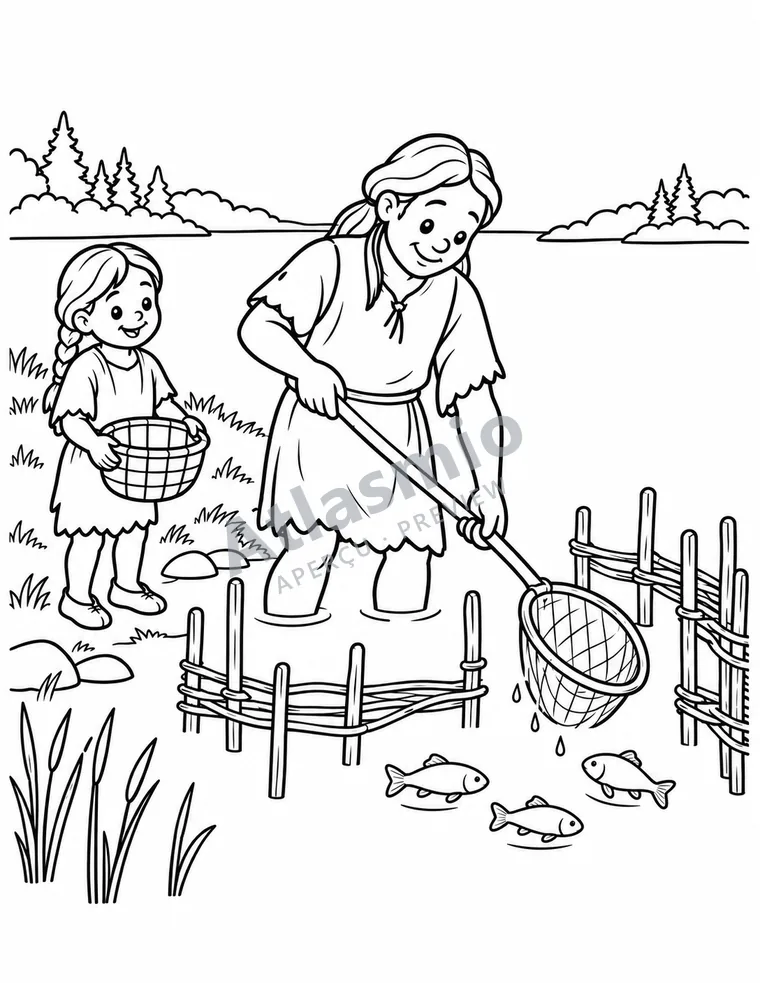
At Mnjikaning, in Ontario, Indigenous peoples fished for about 5,000 years using fences of wooden stakes set in the water. Today, the Anishinaabeg and the Huron-Wendat care for this place.
Look together
How many fish can you count near the fence?
An idea to try
With pencils on a table, make a V-shaped fence with an opening at the tip. Gently push paper fish toward the fence and watch where they end up.
For the adult reading along
A little more to discover
According to Parks Canada, Mnjikaning, at the Atherley Narrows between Lake Simcoe and Lake Couchiching, has the largest and best-preserved wooden fish weirs known in eastern North America. Some stakes are more than 5,000 years old; no one knows which people first used them. The Huron-Wendat cared for the site in the centuries before 1650, and today the Huron-Wendat and Anishinaabeg are its stewards. The Chippewas of Rama First Nation says its community maintained the fence and shared the catch with neighbouring communities.
The channel was first dredged for boats in 1856–1857, and boats and nearby building still threaten the stakes. Around 1830, the Crown also moved the Rama community, which later lost its fishing and hunting rights under the disputed 1923 Williams Treaties, as the Nation explains. More than 70 Indigenous languages are still spoken in Canada. Ask your child how a fence in the water could help people catch fish.
Sources and context (3)
These links lead to other websites. Explore them with an adult. Source titles appear in their original language; some linked pages are in French.
- Parks Canada — Mnjikaning Fish Weirs Historic Site of Canada Management StatementDesignated in 1982; largest and best-preserved wooden fish weirs known in eastern North America, in use from about 3300 B.C. to the recent past; stakes over 5,000 years old whose first users are unknown; Huron-Wendat care before 1650; Huron-Wendat and Anishinaabeg stewards today; a sacred place; channel dredged in 1856–1857; threats from boating and development.
- Chippewas of Rama First Nation — Community HistoryThe Nation’s own account: Rama maintained the fish fence and shared the harvest with the other Chippewa Tri-Council communities; moved by the Crown around 1830; bought land in Rama Township in 1836; lost its right to fish and hunt under the disputed 1923 Williams Treaties; Mnjikaning Fish Fence Circle founded in 1993. Read on the Internet Archive copy of April 22, 2026, because the site blocks automated tools.
- Statistics Canada — Indigenous languages across Canada (2021 Census)More than 70 distinct Indigenous languages are spoken today by First Nations people, Métis and Inuit in Canada.
Source review: 2026-09-24. Illustrations simplify places and scenes; they are not historical documents.