Homes, Trades and Games of Long Ago · Drawing 23 of 40
All aboard, travellers!
The late 19th century
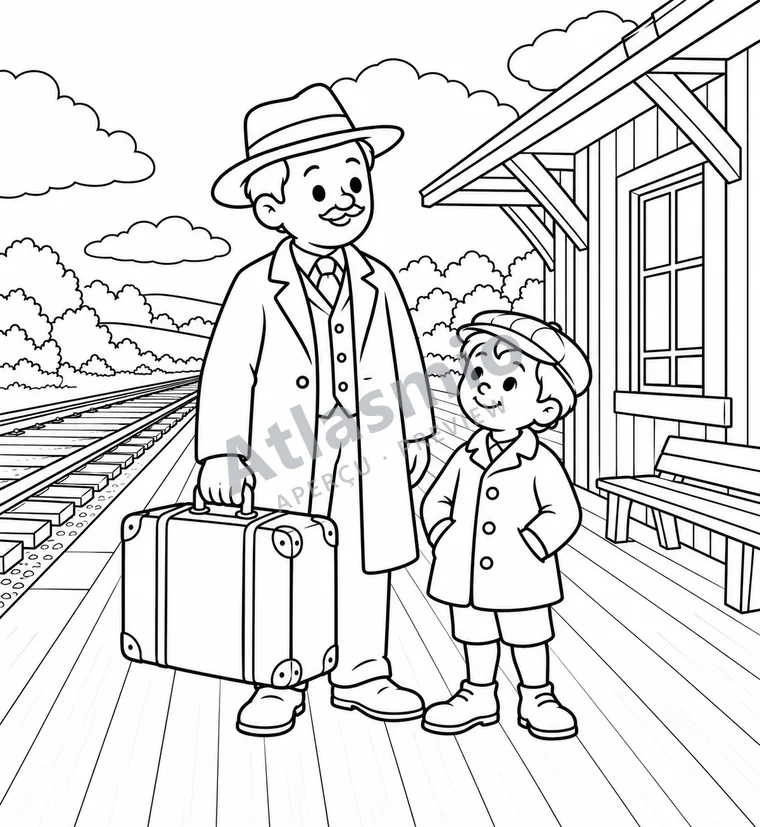
By the late nineteenth century, people could travel between Québec’s cities by train. The travellers wait on the platform with their luggage. Soon they will board a railway car!
Look together
What would you put in your suitcase?
An idea to try
Your child chooses three objects to bring for a night away. Draw them inside a paper suitcase, then talk about what would be useful on the journey and after arriving.
For the adult reading along
A little more to discover
In February 1879, the Québec, Montréal, Ottawa and Occidental Railway opened a direct rail connection between Montréal and Québec City along the north shore. The chronology of UQAM’s Laboratoire d’histoire et de patrimoine de Montréal gives this date, drawing on Histoire de Québec et de sa région. Our drawing does not show an identified station: it evokes waiting for a train journey.
With your child, imagine what would go into a suitcase for a few days. The question brings an old situation close to their experience without inventing where the characters are going. To go further, Exporail in Saint-Constant was founded in 1961; its mission includes preserving and sharing railway heritage.
Sources and illustration notes (2)
An imaginary station, travellers and luggage suggesting the late 19th century; no particular station is reproduced.
These links lead to other websites. Explore them with an adult. References identify the institution and the related lesson; some linked pages are in French.
- Exporail — À propos d’ExporailFondation du musée en 1961, mission de conservation ferroviaire et adresse à Saint-Constant; aucune durée de trajet historique n’est déduite de cette page.
- UQAM, Laboratoire d’histoire et de patrimoine de Montréal — Chemin de fer Québec Montréal Ottawa & OccidentalInauguration en février 1879 du lien ferroviaire direct Montréal–Québec sur la rive nord; référence à Marc Vallières et collaborateurs, p. 1112.
Source review: 2026-09-15. Illustrations simplify places and scenes; they are not historical documents.