
Homes, Trades and Games of Long Ago · Drawing 14 of 40
At the shoemaker's
The 19th century
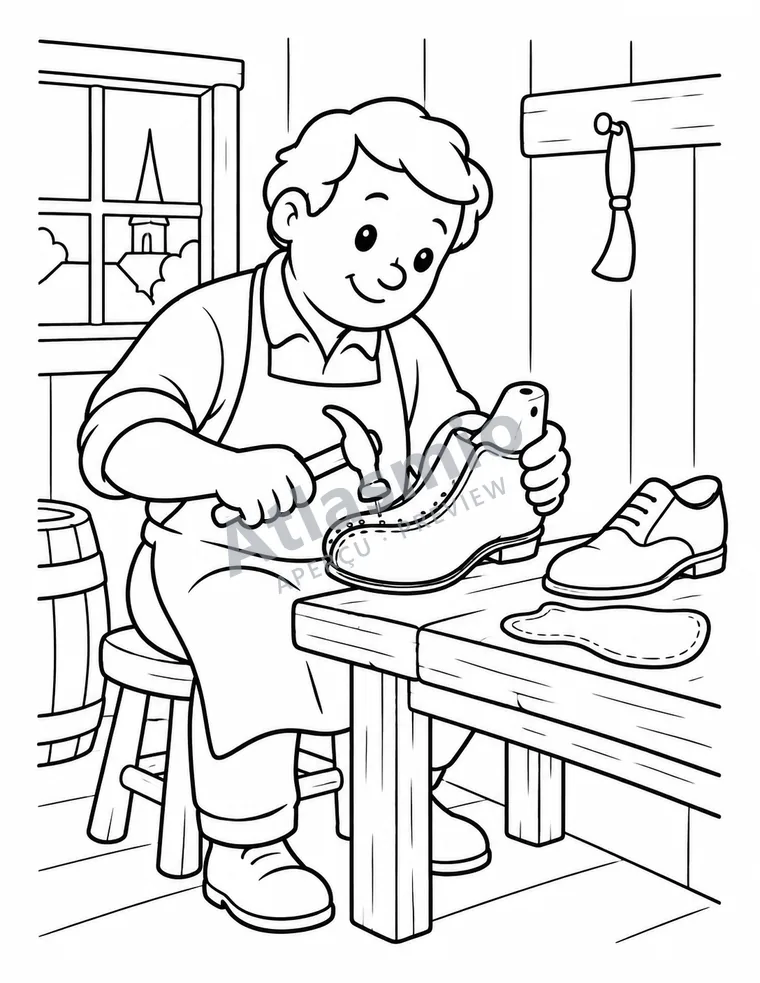
The shoemaker makes and repairs shoes. He stretches the leather over a wooden foot called a last, then nails on the sole with his little hammer.
Look together
Which tools can you see in the workshop?
An idea to try
Examine a clean shoe together. Your child points out its sole, opening and fastenings, then explains which part seems hardest to make.
For the adult reading along
A little more to discover
The shoemaker uses a last to shape a shoe. The Répertoire du patrimoine culturel describes lasting pincers made between 1750 and 1850 and excavated in Montréal. Assembly methods vary with the type of shoe. In Québec City, tanneries grew near rues De Saint-Vallier and Arago, where water was available for leather working. In the 1870s, steam-powered machinery helped shoe factories expand in Saint-Roch, employing thousands of people.
The workshop in the drawing links material, tool and finished object. Invite your child to look at a modern shoe: which parts are soft, which ones hold the foot? The shoemaker is imaginary and does not reproduce a documented repair.
Sources and context (3)
These links lead to other websites. Explore them with an adult. Source titles appear in their original language; some linked pages are in French.
- Répertoire du patrimoine culturel du Québec — Pince à tendreOutil de cordonnier daté de 1750–1850; découverte à Montréal; cuir tendu sur une forme, techniques variant selon les chaussures.
- Ville de Québec — Manufactures de chaussures et industrialisation à QuébecEssor des manufactures de chaussures de Saint-Roch dans les années 1870 et mécanisation à vapeur; pas de total d’effectifs retenu pour 1901.
- Ville de Québec — TanneriesImplantation des tanneries près des rues De Saint-Vallier et Arago, liée à l’accès à l’eau; aucune date de première tannerie déduite de cette page.
Source review: 2026-09-15. Illustrations simplify places and scenes; they are not historical documents.