Homes, Trades and Games of Long Ago · Drawing 11 of 40
The loom
The 19th century
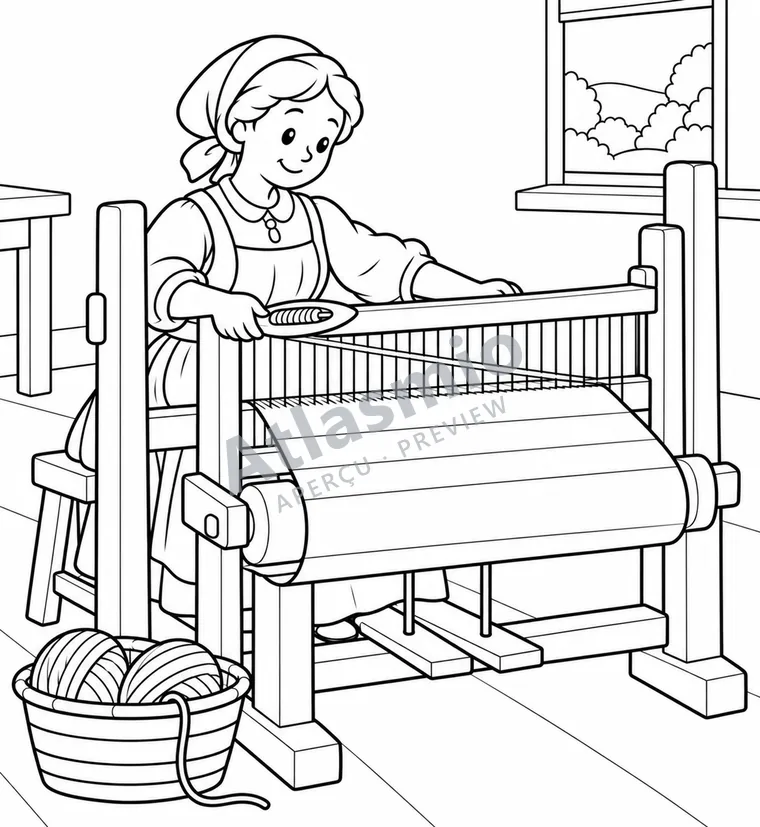
Over, under: on a loom, threads cross to make cloth. Long ago, families wove blankets and clothes at home.
Look together
What is she holding in her hand?
An idea to try
An adult prepares wide strips of paper. Your child weaves a strip over and under the others to make a small checkerboard pattern.
For the adult reading along
A little more to discover
On a loom, the warp threads are stretched lengthwise and the shuttle carries the weft thread over and under: that is how cloth is born. In Québec homes, wool and flax were woven for clothes and blankets, and people made catalogne, a fabric woven from strips of old, reused cloth. Since 1915 the Cercles de Fermières have passed these skills on from person to person; the weaving, knitting and sewing practised in the Cercles are recognized as intangible heritage of Québec.
Connect this scene with the spinning wheel: making a thread and making cloth are two different jobs. In the drawing the weaver holds the shuttle; a few passes over and under with paper strips are enough to show how threads cross.
Sources and illustration notes (3)
A simplified loom and weaving action for colouring; this is not an assembly diagram.
These links lead to other websites. Explore them with an adult. References identify the institution and the related lesson; some linked pages are in French.
- Centre des technologies textiles — Métier à tisser, Grand dictionnaire terminologiqueEntrecroisement des fils de chaîne et de trame; fonctionnement général du tissage.
- Office québécois de la langue française — ChaîneFils disposés dans la longueur du tissu et entrecroisés avec la trame.
- Répertoire du patrimoine culturel du Québec — Savoir-faire textiles transmis au sein des Cercles de FermièresTissage, catalogne, tricot et couture transmis depuis 1915; patrimoine immatériel désigné.
Source review: 2026-09-15. Illustrations simplify places and scenes; they are not historical documents.