Homes, Trades and Games of Long Ago · Drawing 09 of 40
Making butter
Around 1900
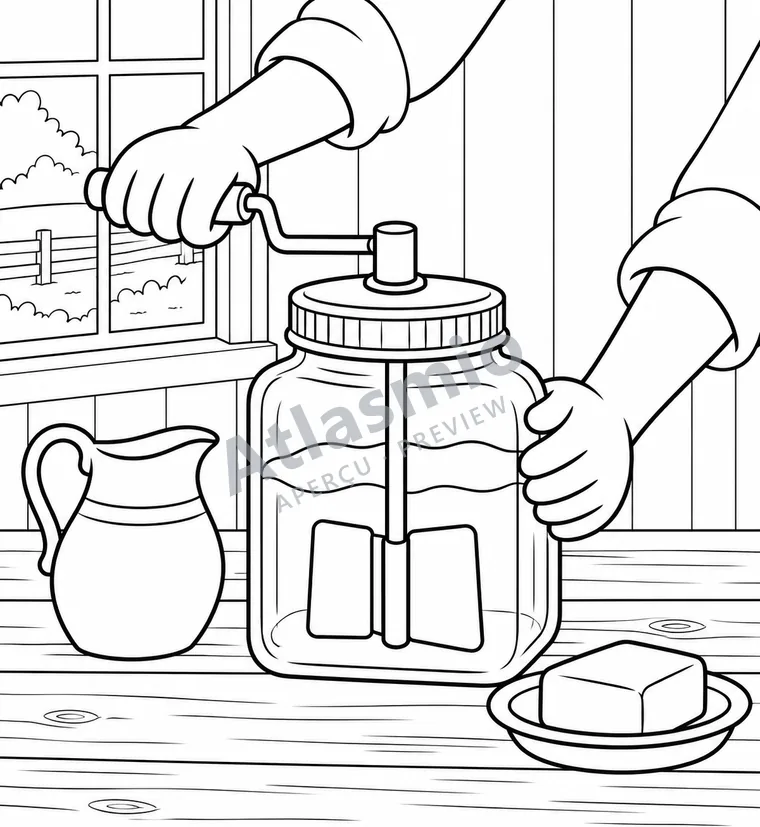
Cream goes into the churn, then the crank is turned for a long, long time. The paddles stir the cream until it turns into butter!
Look together
Which part do you turn by hand?
An idea to try
Pretend to turn a handle slowly, then a little faster. Together, think of another object with a turning handle.
For the adult reading along
A little more to discover
Around 1900, butter was made on farms and in creameries. The Répertoire du patrimoine culturel describes a glass churn with a crank and paddles, made around 1885–1915. Churning cream brings its fat together into grains of butter; the liquid left behind is buttermilk. In 1892, a dairy school opened in Saint-Hyacinthe to teach skills including butter and cheese making.
In the drawing, follow the hand to the crank, then look at the paddles in the jar and the butter already on the plate. Talk about how long it takes to turn one food into another. The mechanism is simplified; the page is not a plan.
Sources and illustration notes (4)
Original simplified illustration for colouring; not a historical document.
These links lead to other websites. Explore them with an adult. References identify the institution and the related lesson; some linked pages are in French.
- Répertoire du patrimoine culturel du Québec — BaratteBaratte de verre à mécanisme manuel et pales; fabrication vers 1885–1915.
- Répertoire du patrimoine culturel du Québec — École de laiterie de Saint-HyacintheOuverture de l’école en 1892 et formation laitière; aucune priorité nord-américaine n’est affirmée.
- OQLF — BabeurreLiquide restant après le barattage de la crème; ne pas confondre avec le petit-lait de la fabrication du fromage.
- Assemblée nationale — Introduction historique, session de 1922École de Saint-Hyacinthe fondée en 1892; enseignement du beurre et du fromage, sans revendiquer une première continentale.
Source review: 2026-09-19. Illustrations simplify places and scenes; they are not historical documents.