
From Stadacona to the REM · Drawing 26 of 36
The métro arrives
1966
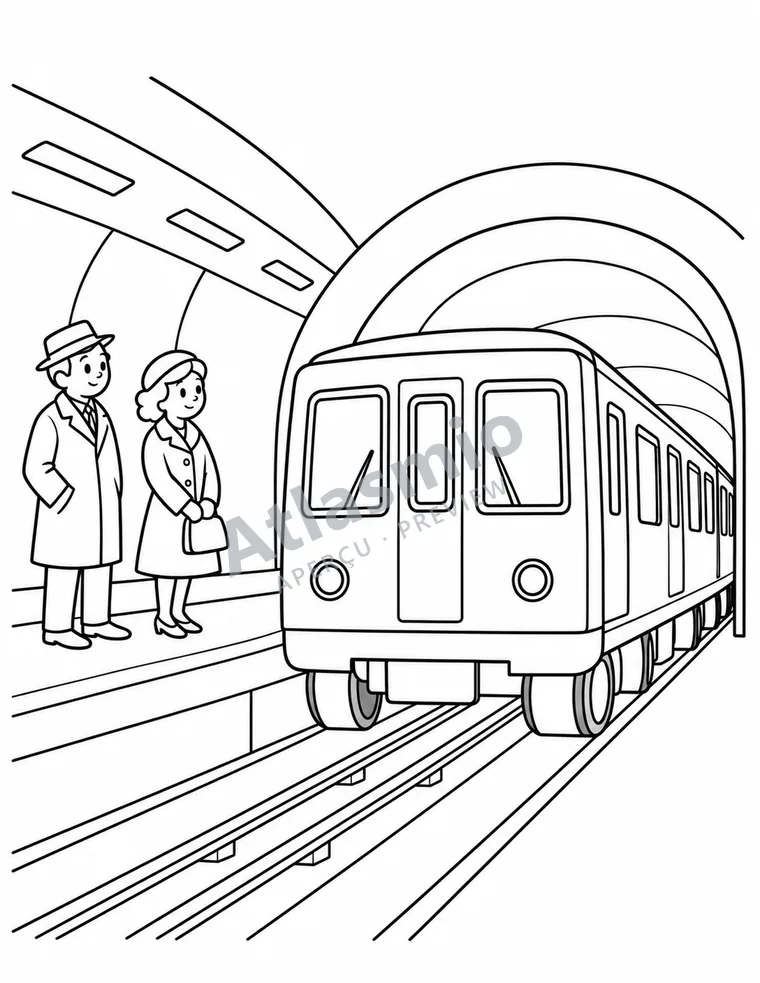
In 1966, Montréal’s métro welcomes its first passengers. Its trains run underground on rubber tires. They carry people without sharing the busy streets with cars.
Look together
Where do people wait for the métro?
An idea to try
Line up three sheets of paper as stations. Your child invents a route with a departure, a stop and an arrival, then tells it using a pretend train.
For the adult reading along
A little more to discover
On October 14, 1966, Mayor Jean Drapeau inaugurated the Montréal métro. Its cars run on rubber tires: it was the first métro in the world entirely on pneumatic tires, a technique borrowed from Paris. The network was completed in time for Expo 67: 26 stations on three lines, green, orange and yellow, the yellow line running under the river to Longueuil. Several architects contributed to the project. The stations have distinctive designs and many contain works of art.
With your child, compare the métro with the electric streetcar in the book. Both carry passengers, but one runs beneath the city away from street traffic. A station is a stop along a trip, not necessarily its destination. The drawing shows no named station and simplifies the cars of the period.
Sources and context (5)
These links lead to other websites. Explore them with an adult. Source titles appear in their original language; some linked pages are in French.
- Société de transport de Montréal — 150 ans de transport collectif, communiqué du 25 novembre 2011
- Encyclopédie du MEM — Le métro de Montréal
- STM — Le métro de Montréal : son histoire
- STM — De l’Église : Claude Théberge, Antoine Lamarche
- STM — Histoire du métro
Source review: 2026-09-19. Illustrations simplify places and scenes; they are not historical documents.