

Provinces and Territories · Drawing 22 of 42
The Red River cart
Manitoba
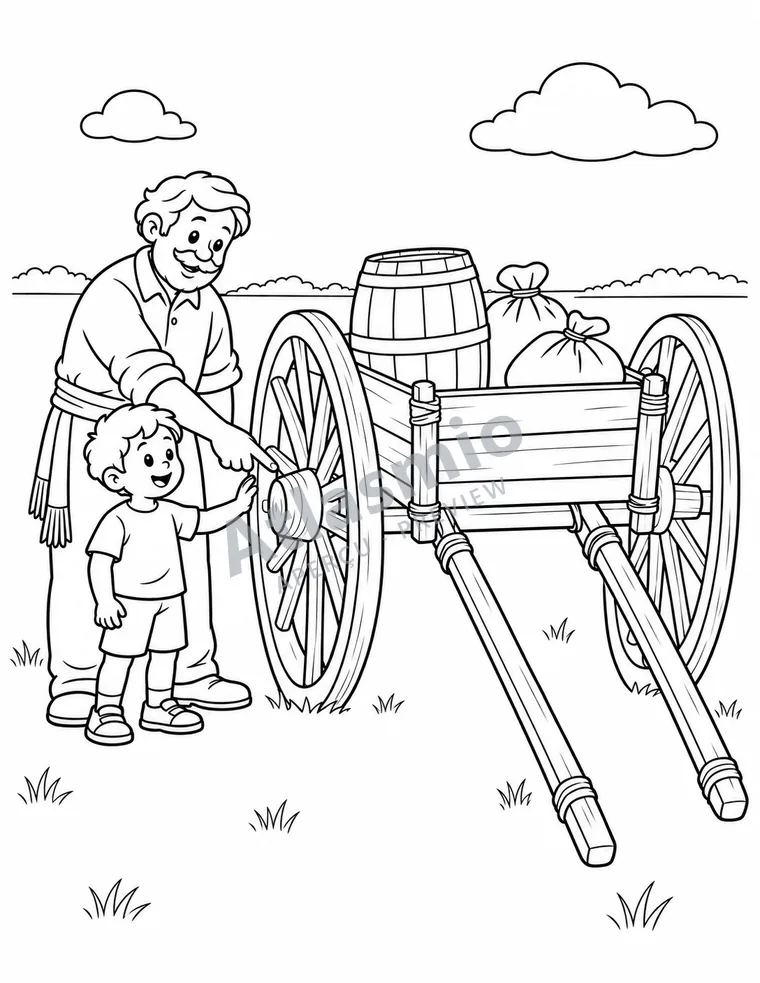
The Métis invented the Red River cart to carry loads across the Prairies. Today, it is a symbol of Métis culture.
Look together
What would you put in the cart?
An idea to try
Draw a big wheel together: a circle, a small circle in the middle, then the spokes. How many spokes did your child draw?
For the adult reading along
A little more to discover
According to the Manitoba Métis Federation, the Red River cart (aen wagon or aen charet in Michif) was made of wood bound with rawhide, with no metal parts. Its large dished wheels rolled through mud and could be removed so the cart could float. The axles were not greased, because grease collects dust, so the wheels squealed loudly enough to be heard far away.
Today, the cart appears on Métis flags, and carts can be seen in museums and parks. The drawing imagines a present-day visit. Talk with your child about inventions that meet a need: how do you carry what you need when there is no road?
Sources and context (2)
These links lead to other websites. Explore them with an adult. Source titles appear in their original language; some linked pages are in French.
- Manitoba Métis Federation — Red River CartThe Métis as innovators of the cart (“aen wagon” or “aen charet” in Michif); wood bound with rawhide, no metal parts; removable dished wheels so it could act as a barge; ungreased axles and loud screeching; a symbol of Métis culture.
- The Canadian Encyclopedia — Red River CartConstructed entirely of wood and used by Métis people on the Prairies; squeal audible for kilometres; presented on Métis flags; still displayed in museums and parks.
Source review: 2026-09-24. Illustrations simplify places and scenes; they are not historical documents.