

Provinces and Territories · Drawing 14 of 42
Maple taffy time
Québec — spring
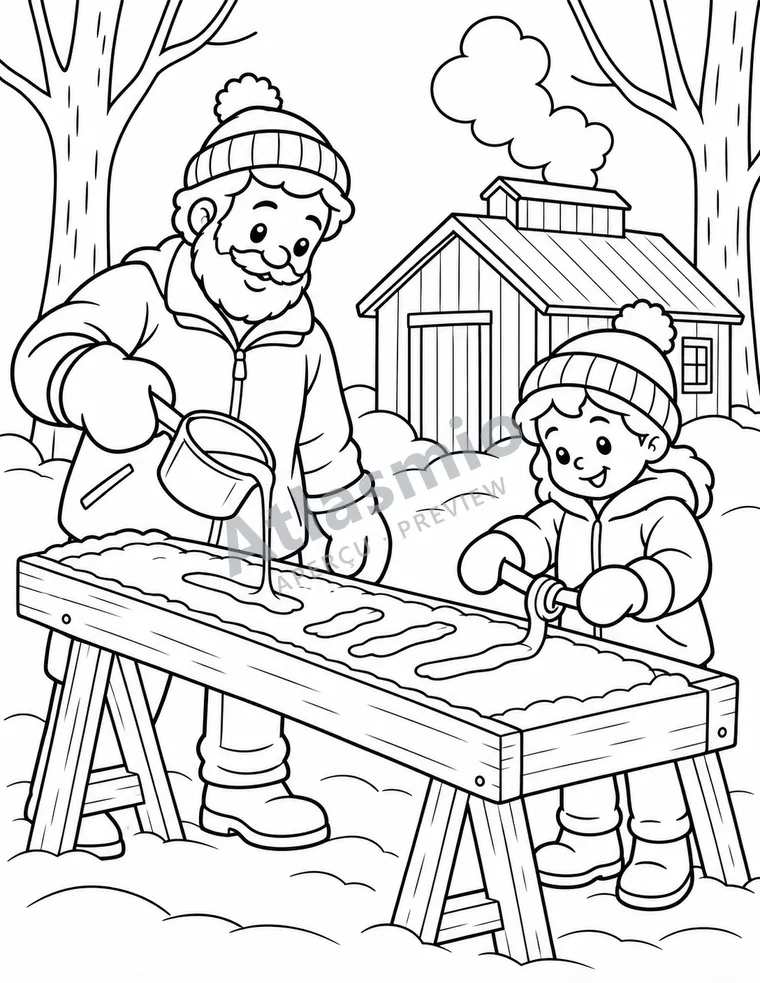
Québec makes most of the world’s maple syrup. At the sugar shack, boiled syrup poured on snow turns into maple taffy!
Look together
What shape would you give your taffy?
An idea to try
Roll a strip of paper around a pencil, like taffy on a stick. How many turns can your child make?
For the adult reading along
A little more to discover
According to Agriculture and Agri-Food Canada, Canada produced more than 75% of the world’s maple syrup in 2025, and 90% of Canadian production came from Québec. New Brunswick, Ontario and Nova Scotia also produce it. For taffy, syrup is boiled down further, then poured in a ribbon onto packed snow, where it hardens and can be twirled around a stick. In 2021, Québec designated its sugaring-season traditions as intangible cultural heritage.
Indigenous peoples have harvested maple sap since long before European settlers arrived. Boiling syrup can burn: the adult pours it, and the child waits for it to cool on the snow. Ask your child what changes when hot meets cold.
Sources and context (3)
These links lead to other websites. Explore them with an adult. Source titles appear in their original language; some linked pages are in French.
- Agriculture and Agri-Food Canada — Statistical overview of the Canadian maple industry, 2025In 2025, Canada accounted for more than 75% of world maple syrup production; 90.0% of Canadian production came from Québec, followed by New Brunswick, Ontario and Nova Scotia.
- Maple from Canada (Québec maple producers’ network) — Maple TaffySyrup is further concentrated into taffy, poured in a thin ribbon onto compacted snow, hardens on contact and is twirled around a stick; a springtime sugar-shack treat.
- The Canadian Encyclopedia — Maple Syrup IndustryIndigenous peoples of the Eastern Woodlands valued maple sap long before European settlers arrived; taffy on snow at sugar shacks; sugaring traditions designated intangible cultural heritage by Québec in 2021.
Source review: 2026-09-24. Illustrations simplify places and scenes; they are not historical documents.