

Canadian history · Drawing 15 of 37
The railway builders
1885
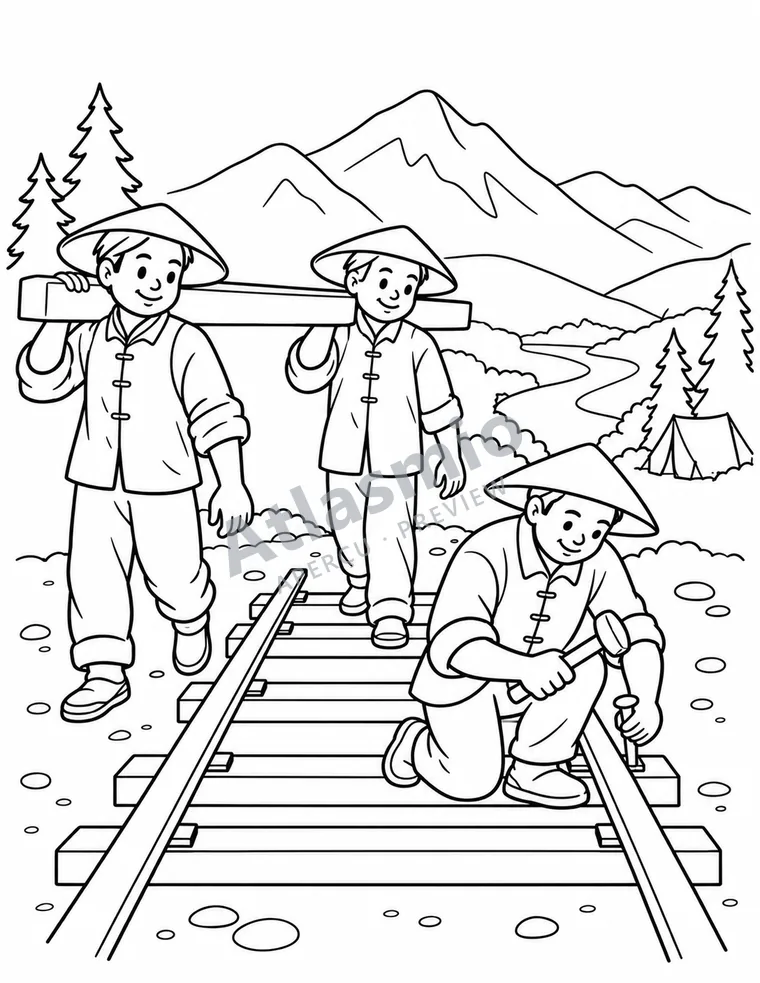
In 1885, the railway across Canada reached the Pacific Ocean. In British Columbia’s mountains, thousands of Chinese workers built some of the hardest parts.
Look together
What are the workers carrying?
An idea to try
Build a small railway with blocks or paper strips over a pile of cushions, your “mountains”. Talk about why building in the mountains is harder than on flat ground.
For the adult reading along
A little more to discover
The last spike was driven at Craigellachie, British Columbia, on November 7, 1885. In the province’s mountains, much of the hardest work had been done by Chinese workers; more than 15,000 came. They were given the most dangerous tasks, many were in debt to recruiters, and they earned about a dollar a day, less than white workers, while paying for their own supplies. Historians estimate that at least 600 died, in accidents or from the cold. No Chinese workers appear in the famous photographs of the last spike.
In 1885, Canada also imposed a head tax on Chinese newcomers, later raised to $500, and from 1923 to 1947 it banned most Chinese immigration. In 2006, the Government of Canada apologized. Many workers stayed and helped build Chinese-Canadian communities. Talk with your child about fairness: what should happen when people do the same work but are not treated the same?
Sources and context (3)
These links lead to other websites. Explore them with an adult. Source titles appear in their original language; some linked pages are in French.
- Chinese Canadian Museum — Canadian Pacific Railway (1881-1885)Chinese workers assigned the most dangerous tasks in the Fraser Canyon and the mountains; deaths from cold, explosions, rockslides and avalanches; debts to recruiters and lower pay than European workers; afterwards they settled across Canada, opening cafés, laundries and market gardens.
- The Canadian Encyclopedia — The “Other” Last SpikeLast spike driven at Craigellachie, Eagle Pass, on 7 November 1885; no Chinese labourers in either image of the Last Spike; one dollar a day and supplies bought from the company store; at least 600 deaths, some estimates in the thousands.
- Government of Canada — Prime Minister Harper offers full apology for the Chinese Head Tax (2006)Over 15,000 Chinese labourers came to help build the Canadian Pacific Railway; head tax of $50 in 1885, raised to $500 in 1903; exclusion from 1923 to 1947; apology of June 22, 2006.
Source review: 2026-09-24. Illustrations simplify places and scenes; they are not historical documents.