

Canadian history · Drawing 09 of 37
A railroad with no trains
1850s
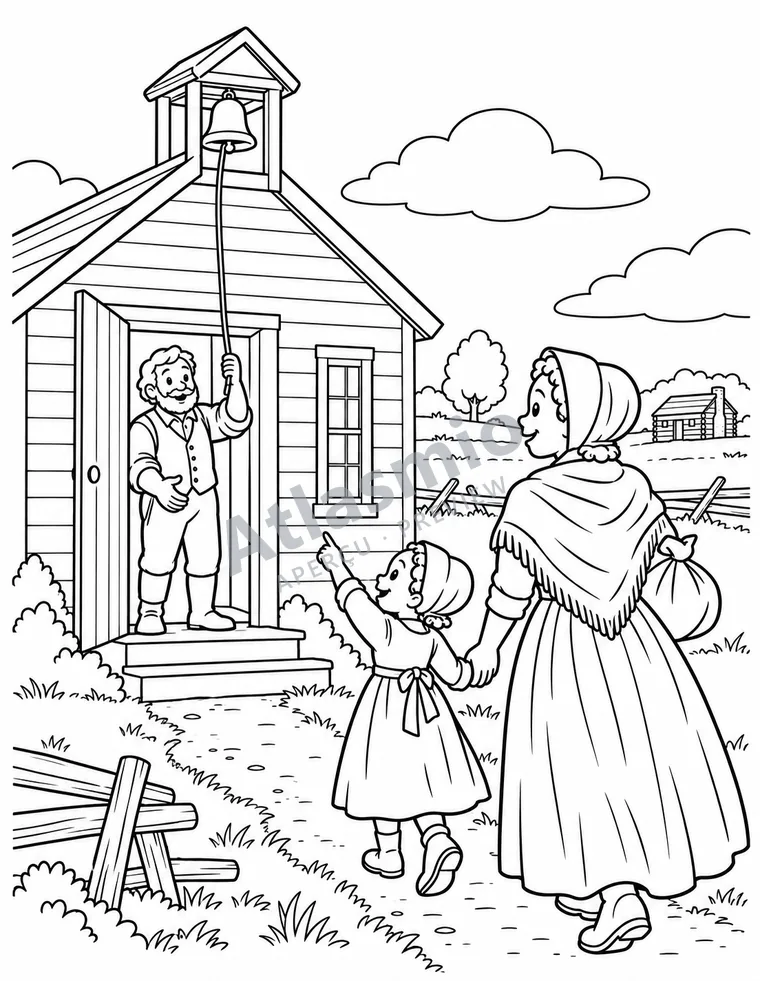
In the 1850s, people escaping slavery in the United States reached Canada West, now Ontario, thanks to the Underground Railroad, a secret network of helpers. At Buxton, a bell rang for each new arrival.
Look together
Why do you think the bell rang for each new arrival?
An idea to try
Ring a small bell or clap once each time someone comes home today. Talk together about how a warm welcome makes people feel.
For the adult reading along
A little more to discover
The American Fugitive Slave Act of 1850 gave slave catchers more power to pursue freedom seekers in the northern states, and arrivals rose sharply: 15,000 to 20,000 people reached the Province of Canada between 1850 and 1860. The Underground Railroad was not a railway but a secret network of people and safe houses; it borrowed railway words such as “conductor” and “station.” At Buxton, the Elgin Settlement, founded in 1849, grew to some 300 families at its peak, with farms, businesses and a school that outperformed its neighbours. Its founder, the Reverend William King, had been a slaveholder in Louisiana; the 15 people he freed were among the first settlers.
Freedom did not mean equality: Black newcomers faced discrimination, and some parts of Ontario had segregated schools. The Buxton bell, a gift in 1850 from Black residents of Pittsburgh, rang daily and for each new arrival; a replica now stands at the Buxton museum. Ask your child how a welcome can help someone feel safe.
Sources and context (3)
These links lead to other websites. Explore them with an adult. Source titles appear in their original language; some linked pages are in French.
- Dictionary of Canadian Biography — KING, WILLIAMBiography by Jason H. Silverman (vol. 12): in Louisiana, King “married the daughter of a wealthy slaveowner, and became a slaveowner himself”; he resolved to bring the people he held to Canada and free them; he arrived at Elgin on November 28, 1849, and “the first black settlers were the 15 slaves he had freed as well as Isaac Riley and his family”; family farms, a brickyard, sawmill, grist-mill and general store; 130 families by 1853 and 300 at the settlement’s peak; a school soon recognized as superior to the district school.
- The Canadian Encyclopedia — Underground RailroadA secret network, not an actual railroad; railway terms such as “conductors” and “stations”; arrivals rose after the 1850 Fugitive Slave Act; 15,000 to 20,000 reached the Province of Canada between 1850 and 1860; Buxton among the destinations; segregated schools in parts of Ontario.
- Community Stories (Digital Museums Canada, Harriet Tubman Institute) — The Liberty BellBell given in 1850 by Black Pittsburghers; first steeple bell west of London, Ontario; it rang daily and marked each arrival of a freedom seeker; a 2007 replica stands at the Buxton museum.
Source review: 2026-09-24. Illustrations simplify places and scenes; they are not historical documents.