

Canadian history · Drawing 06 of 37
Where the river narrows
1608
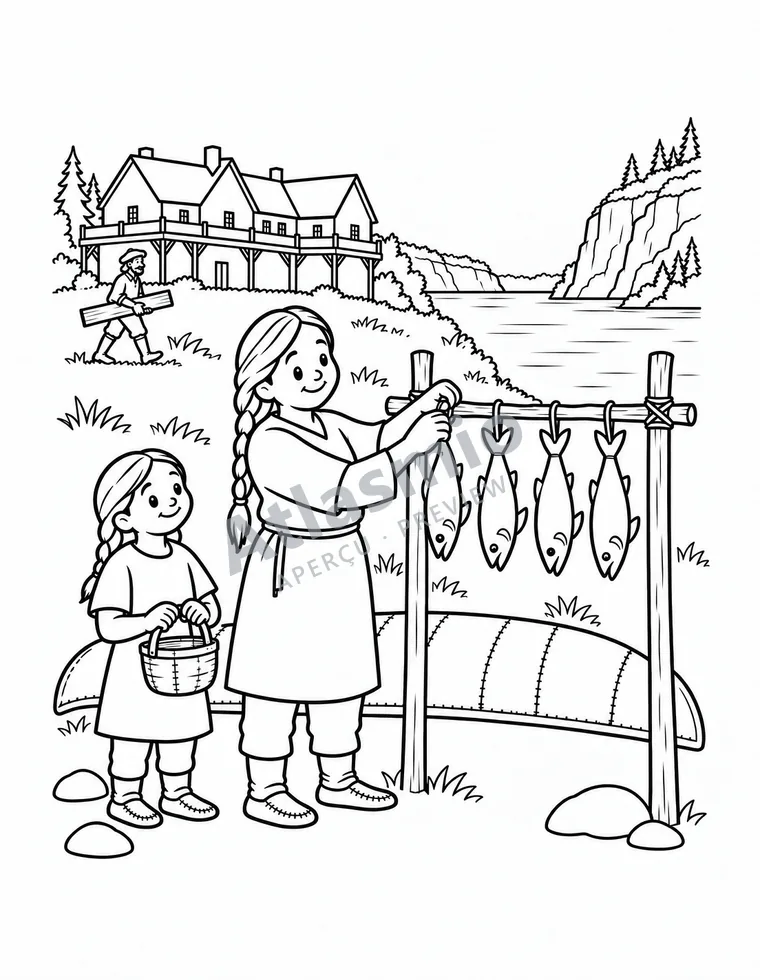
In 1608, Samuel de Champlain’s Habitation began the French settlement at Québec. Innu families already gathered here in summer, where the river narrows.
Look together
What is drying on the wooden rack?
An idea to try
Pinch a piece of string or a scarf in the middle to show how a river narrows. Ask why a narrow place might be handy for crossing, fishing or meeting.
For the adult reading along
A little more to discover
Champlain reached the point of Québec on July 3, 1608, sent by Pierre Dugua de Mons to found a settlement where the fur trade could be controlled. His men built a storehouse and three two-storey wooden buildings with a gallery. Stadacona, the Iroquoian village Cartier had visited, was gone; Algonquian peoples, likely the Innu, then called Montagnais, came to the site. For the Innu of Essipit, it is Uepishtikueiau, “where the river narrows,” one of their main summer gathering places.
That first winter, 16 of the 25 Frenchmen died of scurvy. Champlain’s alliances with the Innu, Algonquin and Wendat also drew him, from 1609, into their wars against the Haudenosaunee. Essipit notes that colonial policies erased many Innu place names and that Innu families still live on this land. Ask your child why the same place can have two names.
Sources and context (3)
These links lead to other websites. Explore them with an adult. Source titles appear in their original language; some linked pages are in French.
- The Canadian Encyclopedia — Samuel de ChamplainArrived off Cap Diamant on July 3, 1608, sent by Dugua to settle where the fur trade could be controlled; storehouse and three two-storey buildings with a gallery; 16 of 25 men died of scurvy; alliances with the Montagnais, Algonquin and Wendat; 1609 clash with the Haudenosaunee.
- The Canadian Encyclopedia — Quebec CityBy 1608 the people of Stadacona had disappeared and been replaced by occasional nomadic Algonquians, likely Montagnais-Naskapi; the name Quebec probably comes from an Algonquian word meaning “narrowing of the river.”
- Innu First Nation of Essipit — Tshitassinu tshiuetunussit (French-language page)Innu voice: ancestors called “Montagnais” by the first explorers; Uepishtikueiau, “where the river narrows,” one of the main Innu summer gathering sites, where Québec City was established; Innu place names erased by colonial policies; Innu families still active on the land.
Source review: 2026-09-24. Illustrations simplify places and scenes; they are not historical documents.