Science Secrets · Drawing 23 of 40
A Comet in the Night
Space · An imagined view
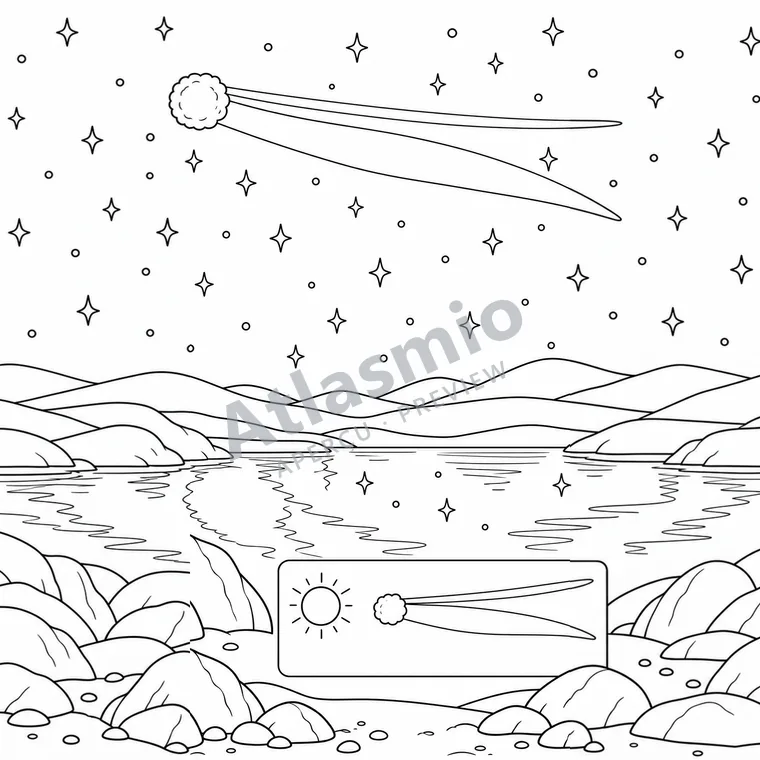
A comet contains ices, dust and rock. Near the Sun, it releases gas and dust. Tails can then stretch generally away from the Sun.
Did you know?
A comet can have a dust tail and a gas tail.
Look together
What differences do you see between the two tails?
An idea to try
Draw a Sun and comet. Put its tail on the side away from the Sun and explain your choice.
For the adult reading along
A little more to discover
The ion tail is directed by the solar wind; the dust tail is more curved. The Sun is not drawn in the night view. The separate small diagram shows the tails on the side away from the Sun; it does not represent its position in the landscape or real distances. The comet and its structures are enlarged and simplified for readability. This imagined view is not a photograph.
Sources and illustration notes (1)
Simplified scene and shapes. Models, imagined comparisons and enlargements do not preserve all real measurements.
These links lead to other websites. Explore them with an adult. References identify the institution and the related lesson; some linked pages are in French.
- NASA Science: CometsA comet contains ices, dust and rock. Near the Sun, it releases gas and dust. Tails can then stretch generally away from the Sun.
Source review: 2026-10-13. Illustrations are simplified for colouring.