Dinosaurs Around the World · Drawing 36 of 40
How Does a Fossil Form?
Fossils and Science
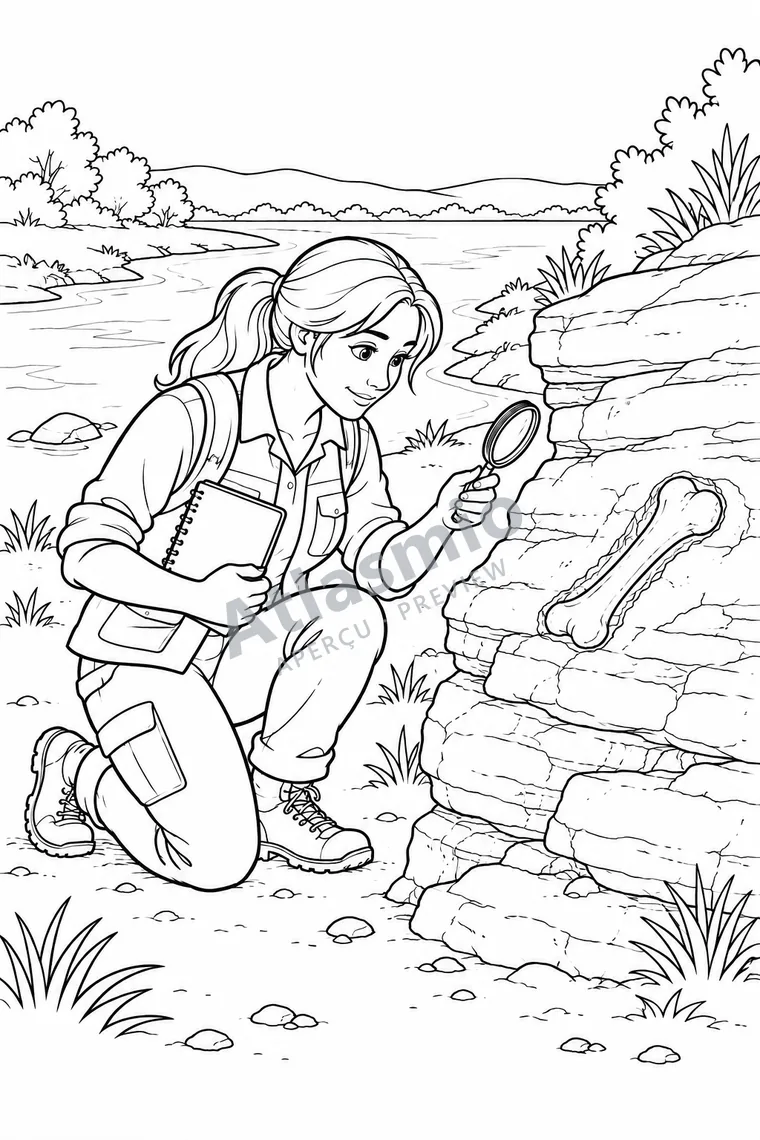
Buried remains can sometimes become fossils. Sediment covers them; over time, the layers change.
Did you know?
Most living things do not become fossils.
Look together
Find the fossil and the rock layers around it.
An idea to try
Imagine with an adult what might have covered these remains long ago.
For the adult reading along
A little more to discover
The palaeontologist observes a fossil in exposed rock beside a river. The scene takes place long after burial; it is not a sequence of stages or an identified real site. Fossilization is rare. Rapid burial can protect some remains; later, erosion can help expose a fossil. The bone’s shape is illustrative and does not identify a species.
Look together: find the rock layers, fossil and river. Imagine what might have covered the remains and what could remove some rock. Real fossil collecting requires the permissions appropriate to the location.
Sources and illustration notes (1)
Simplified reconstruction. Pose, unpreserved tissues and setting are interpreted. Choose your own colours; animals are not to one scale.
These links lead to other websites. Explore them with an adult. References identify the institution and the related lesson; some linked pages are in French.
- Natural History Museum: How Does a Fossil Form?Follow one simplified route from burial to preservation in rock.
Source review: 2026-10-03. Illustrations are simplified for colouring.