Dinosaurs Around the World · Drawing 02 of 40
Continents That Move
Fossils and Science
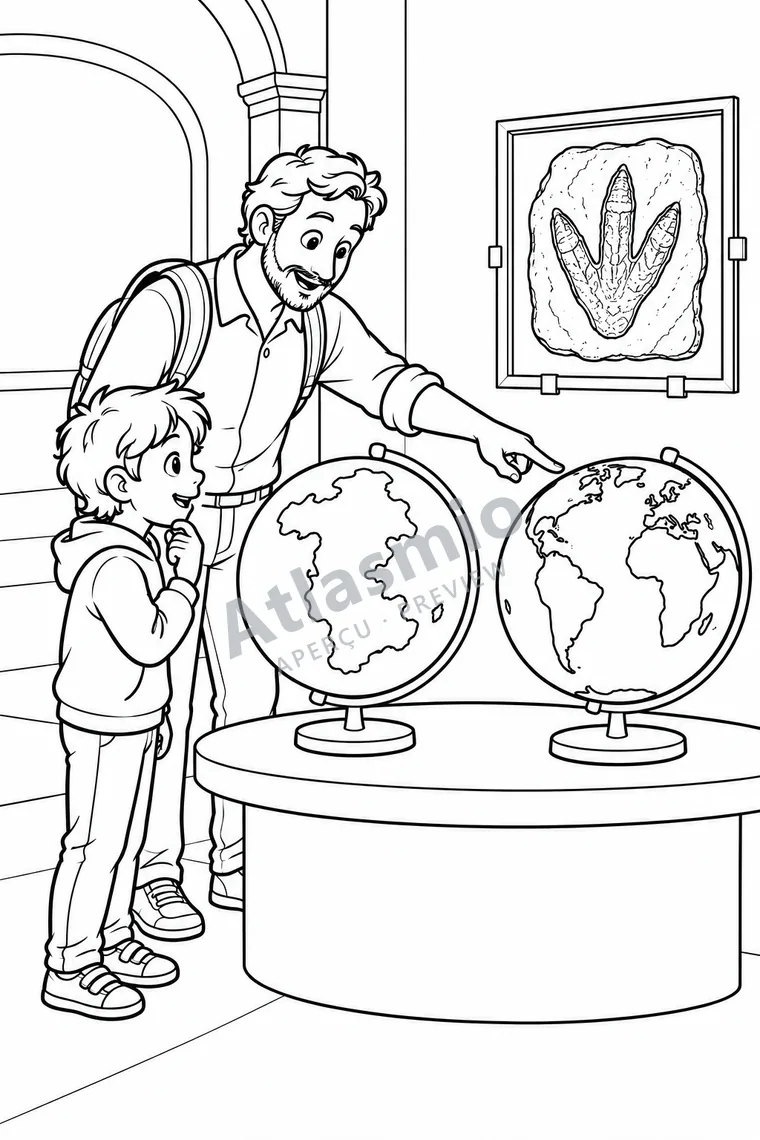
Early in dinosaur history, large landmasses were joined in Pangaea. The continents gradually separated.
Did you know?
Continents still move very slowly.
Look together
What differences do you notice between the two models?
An idea to try
Discuss with an adult which clues this picture helps you explore.
For the adult reading along
A little more to discover
The two museum globes compare a connected large landmass and separated continents. The Pangaea outline is illustrative, without reconstructing exact coastlines. The map at the start of the book shows present-day continents; a modern fossil location is not an ancient boundary. Plates continue to move slowly.
Look together: What differences do you notice between the two models? Discuss with an adult which clues this picture helps you explore.
Sources and illustration notes (2)
Simplified museum models; outlines and sizes are illustrative, without precise geographical measurements.
These links lead to other websites. Explore them with an adult. References identify the institution and the related lesson; some linked pages are in French.
- U.S. Geological Survey: Where did dinosaurs live?Pangaea at the beginning of the dinosaur age and gradual continental separation.
- U.S. Geological Survey: How fast do tectonic plates move?Slow continuing movement of tectonic plates.
Source review: 2026-10-03. Illustrations are simplified for colouring.