Canadian wildlife · Drawing 40 of 40
Narwhal
In the Arctic
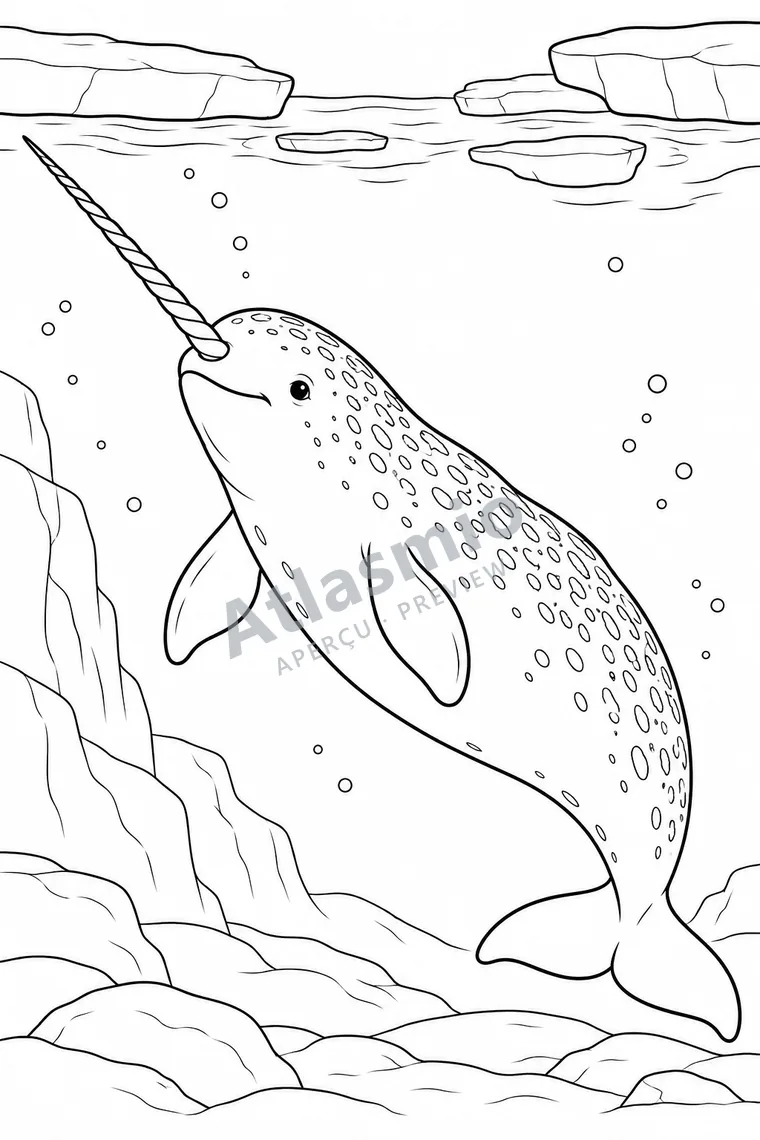
The narwhal lives in Arctic seas. It travels among the ice and comes up to breathe through passages where the water remains open.
Did you know?
Its long tusk is a tooth that grows mainly in males.
Look together
Can you see the tusk extending from the front?
An idea to try
Draw several pieces of ice, leaving a water route between them.
For the adult reading along
A little more to discover
Scientific name: Monodon monoceros. Where it lives: Canadian Arctic waters, including the Baffin Bay region. What it eats: Fish and other marine animals, varying by season and location. The tusk grows from the upper jaw. Most females do not have one. Narwhals breathe through openings in the ice; they cannot break through thick sea ice.
Look together: Can you see the tusk extending from the front? Draw several pieces of ice, leaving a water route between them.
Sources and illustration notes (2)
Simplified drawing for colouring. Coat, feather or skin markings are left white so children can choose their colours. Proportions and details are not a scientific identification plate.
These links lead to other websites. Explore them with an adult. Source titles appear in their original language; some linked pages are in French.
- Fisheries and Oceans Canada — Researching Themes: Population Dynamics, NarwhalTusk as tooth, sex variation, Arctic distribution, feeding and breathing openings.
- Fisheries and Oceans Canada — Narwhal management planLeft upper tooth forms the usual male tusk.
Source review: 2026-09-30. Illustrations are simplified for colouring.