Canadian wildlife · Drawing 38 of 40
Atlantic Walrus
In the Arctic
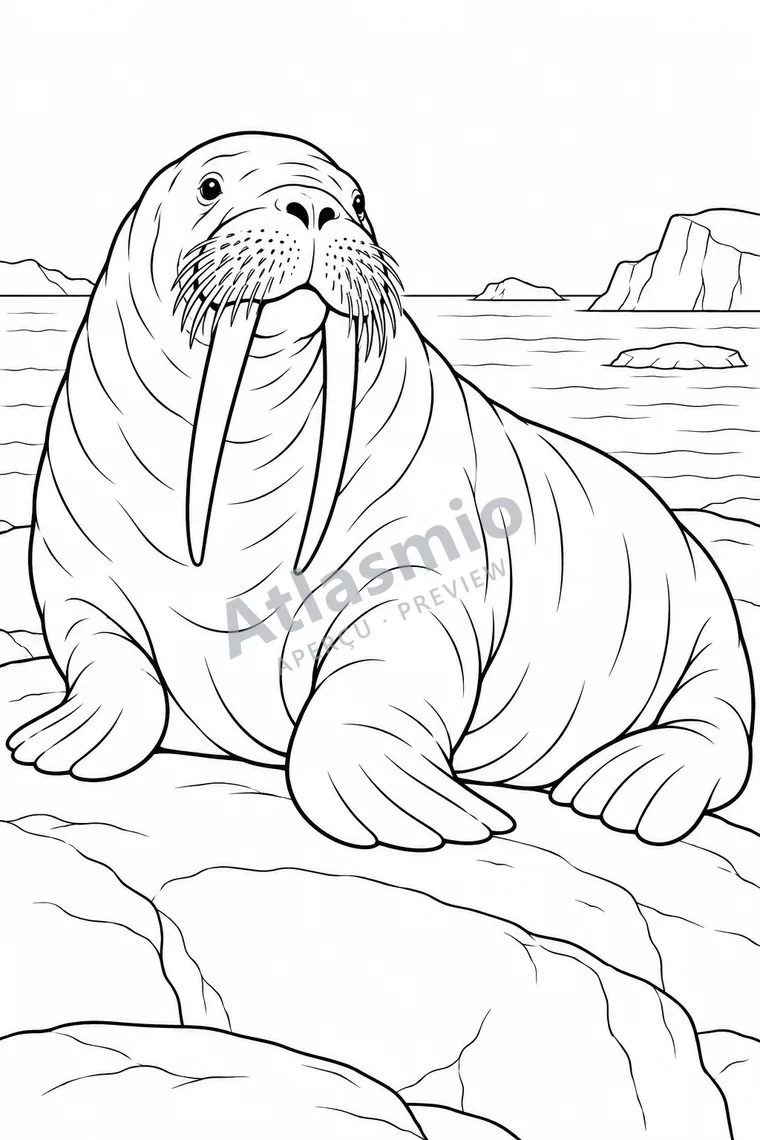
The Atlantic walrus rests on ice or northern shores. It dives into the water to search for food on the bottom of the sea.
Did you know?
Its long tusks are teeth, found in both males and females.
Look together
Can you find its two long tusks?
An idea to try
Draw two long curves for tusks, then add short whiskers.
For the adult reading along
A little more to discover
Scientific name: Odobenus rosmarus rosmarus. Where it lives: Central and eastern Canadian Arctic waters. What it eats: Mostly shellfish, particularly bivalves. It rests on land or ice near feeding areas. Its tusks grow from the upper jaw; they are teeth rather than horns.
Look together: Can you find its two long tusks? Draw two long curves for tusks, then add short whiskers.
Sources and illustration notes (1)
Simplified drawing for colouring. Coat, feather or skin markings are left white so children can choose their colours. Proportions and details are not a scientific identification plate.
These links lead to other websites. Explore them with an adult. Source titles appear in their original language; some linked pages are in French.
- Fisheries and Oceans Canada — Atlantic WalrusUpper canine tusks in both sexes, feeding on bivalves, haul-outs and Canadian distribution.
Source review: 2026-09-30. Illustrations are simplified for colouring.