

Homes, Trades and Games of Long Ago · Drawing 18 of 40
The lumber camp
Long ago, in winter
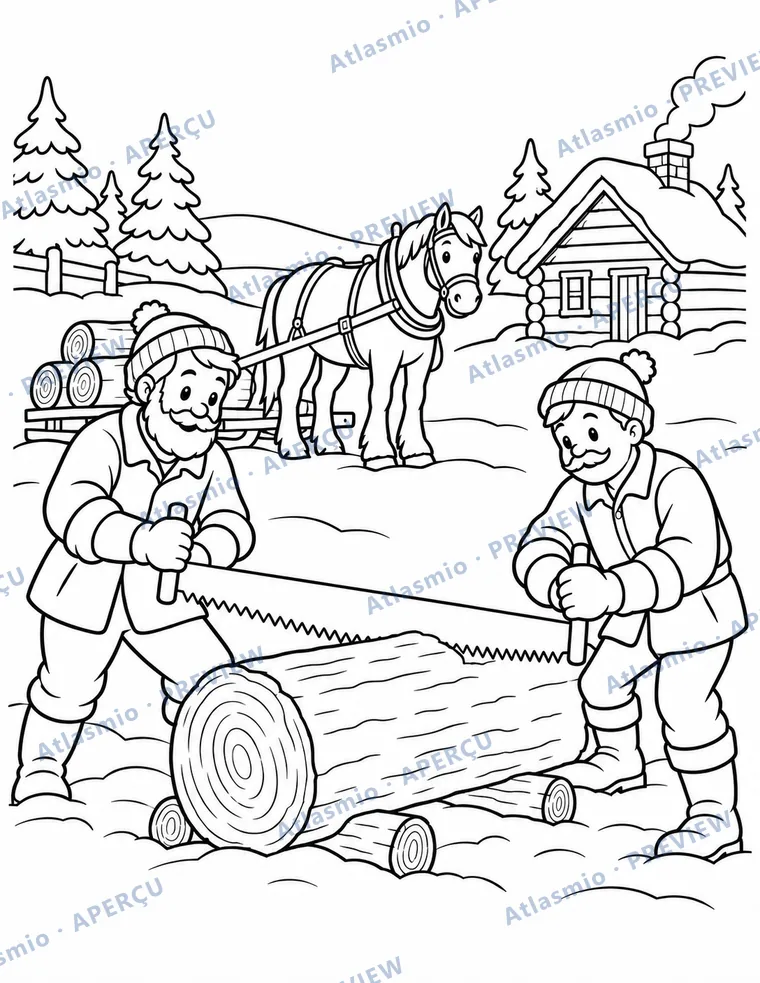
In winter, lumberjacks lived in forest camps. Working in pairs, they cut logs with a long crosscut saw. Horses pulled the logs over the snow.
Look together
How many people does it take to pull the big saw?
An idea to try
In pairs, mime the back-and-forth of a long saw, each pulling in turn. Talk about what can be made from the wood of a single tree.
For the adult reading along
A little more to discover
In the 19th and 20th centuries, forest camps housed workers during the cold season. Tools changed: crosscut saws became widespread toward the end of the 19th century, before powered saws. Camp remains also tell us about meals and shared daily life.
The drawing shows a log already on the ground. Ask your child how the two workers coordinate their movements.
Sources and illustration notes (3)
Imaginary lumber camp; simplified tools, no dangerous gesture shown up close.
These links lead to other websites. Explore them with an adult. References identify the institution and the related lesson; some linked pages are in French.
- Archéolab.Québec — Le camp de bûcheron : une communauté en forêt (in French)Camps of four to ten buildings with a kitchen, dining hall, stable and sometimes a forge; leaving for the camps every fall.
- Répertoire du patrimoine culturel du Québec — Lame de godendard (in French)Crosscut saw six to eight feet long, worked by two men; replaced the axe around 1890; later replaced by the bucksaw, then the chainsaw.
- Boréalis — Mémoires de chantier : que mangeaient les bûcherons? (in French)The central role of the cook in the camps, based on first-hand accounts.
Page prepared on September 19, 2026. Illustrations simplify places and scenes; they are not historical documents.
This drawing is from the book Life in Old Québec to Colour
Tax calculated at checkout. Terms of sale