Homes, Trades and Games of Long Ago · Drawing 01 of 40
Looking around the museum
Today
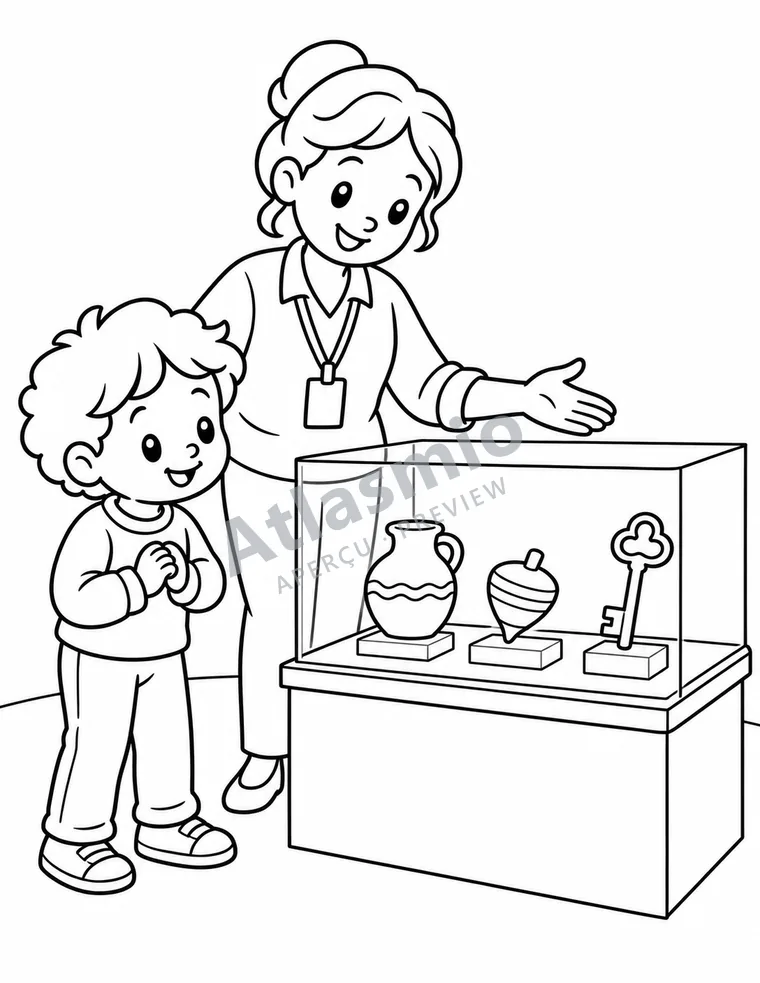
In the display case: a jug, a spinning top and a key. People used these objects long, long ago. If we look closely, we can guess how they lived.
Look together
Which of the three objects would you like to hold?
An idea to try
Choose an everyday object at home. Ask your child to name three details they can see, then imagine a question a museum visitor might ask about it.
For the adult reading along
A little more to discover
This museum is imaginary, but two real Québec museums are built for exactly this kind of discovery. The Musée de la civilisation in Québec City opened on October 19, 1988, in a building by architect Moshe Safdie, and invites very young children to compare objects from yesterday and today. In Montréal, Pointe-à-Callière was inaugurated on May 17, 1992, for the city’s 350th birthday, on the very spot where Ville-Marie was founded in 1642: the museum stands over the remains uncovered by archaeologists.
With your child, separate what can be seen from what can only be guessed. A jug has a handle; knowing who owned it takes other clues. That way of looking, shape, material, use, is how archaeologists work, and it serves on every page of this book.
Sources and illustration notes (4)
An imaginary museum, display case and visitors; no particular collection is reproduced.
These links lead to other websites. Explore them with an adult. References identify the institution and the related lesson; some linked pages are in French.
- Musée de la civilisation — Le Québec autrement dit, petite enfanceDécouverte du Québec et de ses objets auprès des jeunes enfants.
- Musée de la civilisation — Profil institutionnelOuverture au public le 19 octobre 1988.
- Pointe-à-Callière — À proposInauguration le 17 mai 1992 sur le lieu de fondation de Montréal (1642).
- Musée de la civilisation — Le Musée se dote d’un toit vert et communautaireArchitecture du Musée par Moshe Safdie.
Source review: 2026-09-15. Illustrations simplify places and scenes; they are not historical documents.