

From Stadacona to the REM · Drawing 01 of 36
5,000 Years by the St. Lawrence
For about 5,000 years
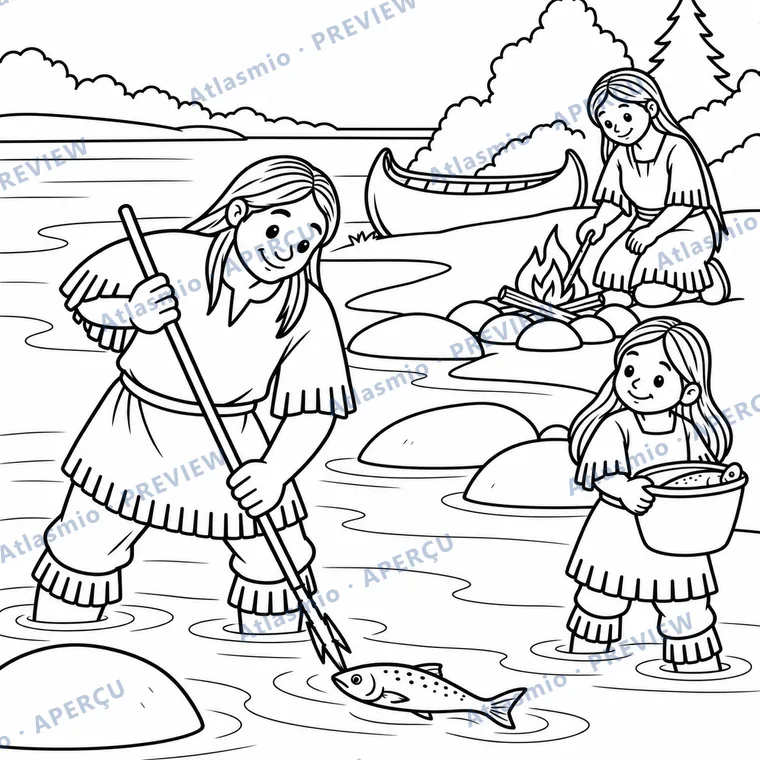
For about 5,000 years, Indigenous peoples came to Pointe-du-Buisson to camp and fish. Archaeologists find the objects they left behind, from many different times. This drawing imagines a fishing camp beside the river.
Look together
What is the person holding the long spear doing?
An idea to try
Bury three objects too big to swallow (a spoon, a jar lid, a large toy) in a tub of sand and let your child uncover them with a paintbrush, like an archaeologist. Talk about what an object can tell about the people who used it.
For the adult reading along
A little more to discover
Pointe-du-Buisson is in Beauharnois, beside the St. Lawrence. Its archaeological sites document about 5,000 years of human presence. Fishing camps and recovered objects do not all belong to the same period: they cannot be combined into one scene dated 5,000 years ago.
The drawing evokes fishing without assigning this camp to a specific nation or date. Help your child distinguish observed remains from archaeologists’ interpretations.
Sources and illustration notes (2)
Imaginary fishing camp; no reconstruction of a specific site or community.
These links lead to other websites. Explore them with an adult. References identify the institution and the related lesson; some linked pages are in French.
- Société des musées du Québec — Pointe-du-Buisson, Musée québécois d’archéologieA 21-hectare site, 17 archaeological sites, more than 2 million objects, 5,000 years of history; a portage at the foot of the rapids.
- Répertoire du patrimoine culturel du Québec — Site archéologique de la Pointe-du-Buisson (in French)Occupied for nearly 5,000 years; Iroquoian fishing camps from the Late Woodland period.
Page prepared on September 19, 2026. Illustrations simplify places and scenes; they are not historical documents.

This drawing is from the book Québec’s Great Moments to Colour
Tax calculated at checkout. Terms of sale