

Provinces and Territories · Drawing 35 of 42
Northern lights over Yellowknife
Northwest Territories
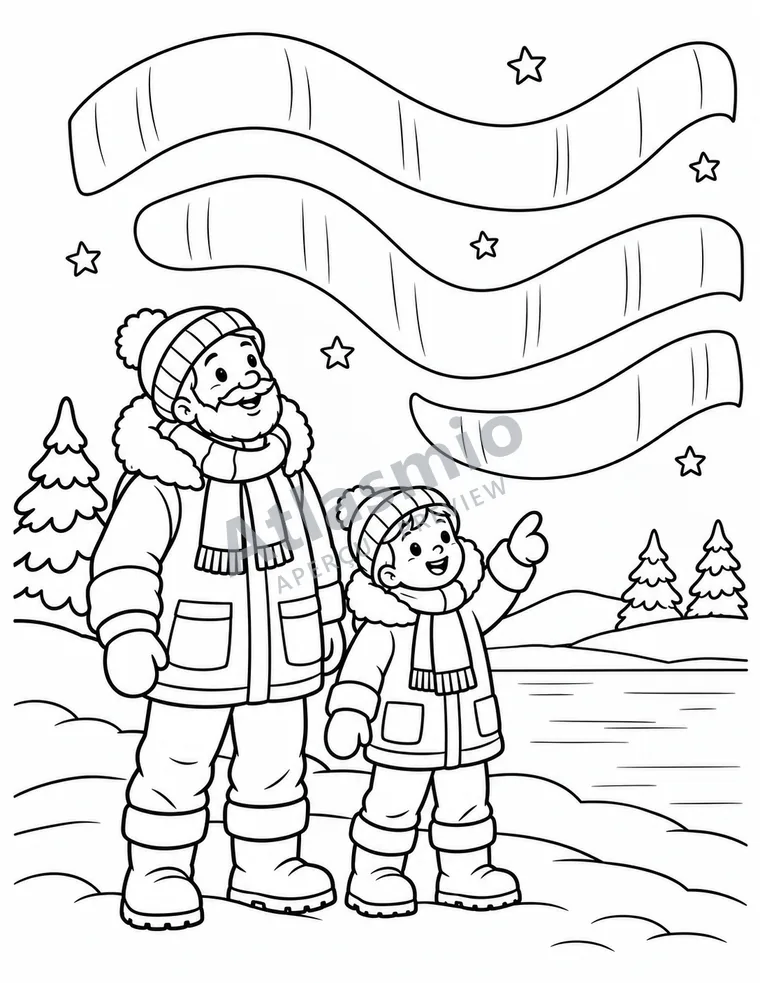
In Yellowknife, people can admire the northern lights during long winter nights. The lights appear when tiny particles from the Sun hit the air high above the Earth.
Look together
What colours would you give the northern lights?
An idea to try
In a dark room, wave a light scarf in front of a flashlight beam to make a dancing “aurora” on the wall.
For the adult reading along
A little more to discover
The Canadian Space Agency explains that the Sun sends out charged particles, called the solar wind. Guided by Earth’s magnetic field, some of them collide with gases in the upper atmosphere, and these collisions produce light. Auroras are more frequent near the spring and fall equinoxes and easier to see in winter, when nights are darker. The City of Yellowknife describes Yellowknife as one of the best places in the world to see them, especially from mid-November to early April.
Yellowknife lies within the homelands of the Yellowknives Dene First Nation, the Tłı̨chǫ people and the North Slave Métis. On a clear night, move away from bright lights, dress warmly and look all around the sky, not only north. Let your child describe the shapes and colours: there is no wrong answer.
Sources and context (3)
These links lead to other websites. Explore them with an adult. Source titles appear in their original language; some linked pages are in French.
- Canadian Space Agency — What are the northern lights?Solar wind of charged particles; role of Earth’s magnetic field; collisions with gases in the upper atmosphere; auroras more common near the equinoxes and easier to see in winter.
- Canadian Space Agency — Aurora viewing tipsChoose a place free of light pollution; look all around, not only north; bundle up.
- City of Yellowknife — Weather and Aurora BorealisOne of the best places in the world to view the aurora, especially mid-November to early April; acknowledgement of the homelands of the Yellowknives Dene First Nation, the Tłı̨chǫ people and the North Slave Métis.
Source review: 2026-09-24. Illustrations simplify places and scenes; they are not historical documents.