

Provinces and Territories · Drawing 26 of 42
Fossils among the hoodoos
Alberta
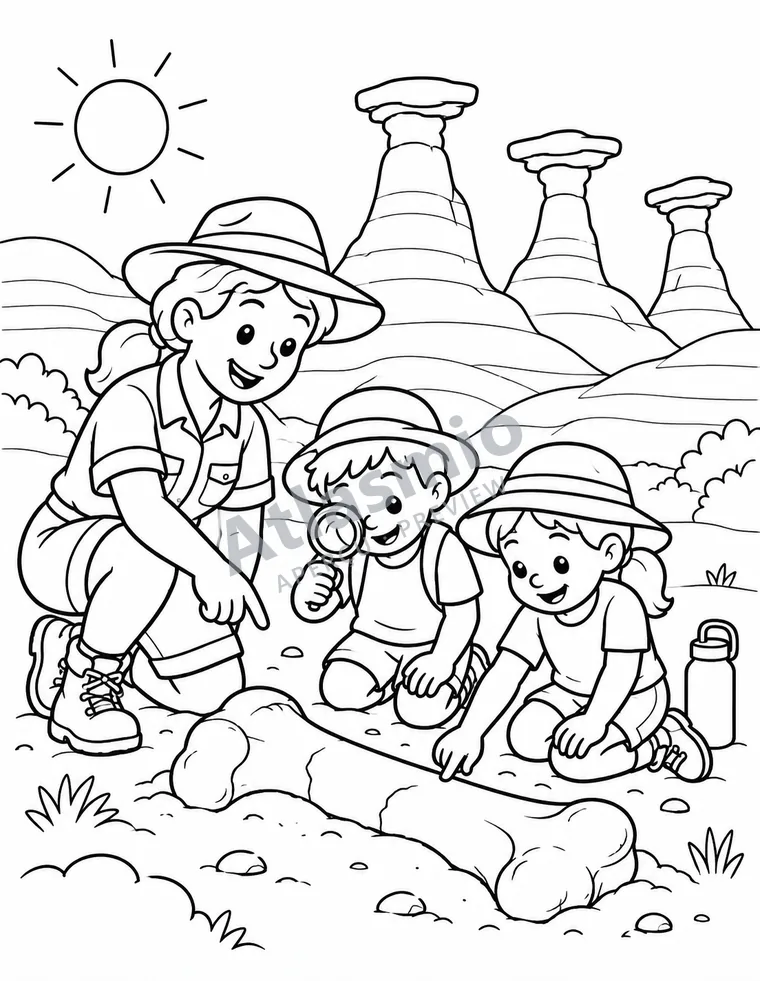
In Alberta, dinosaurs lived about 75 million years ago. Among the hoodoos, a guide helps children spot fossil bones, without digging.
Look together
Where can you see the dinosaur bone?
An idea to try
Draw a big bone, then invent together the dinosaur it might have belonged to: its size, its tail, its colour.
For the adult reading along
A little more to discover
Dinosaur Provincial Park, in southeastern Alberta, has been on UNESCO’s World Heritage List since 1979. About 75 million years ago, the region was a subtropical coastal plain; the bones of some animals, buried in sand and mud, became fossils. Much later, glacial meltwater carved the valley and its hoodoos. Dozens of dinosaur species have been found here, and since 1985 the park’s largest collection has been kept at the Royal Tyrrell Museum in Drumheller.
On family tours, a guide helps visitors spot and touch fossils found in the field; to protect the sites, no one digs. Ask your child which animal the bone might have belonged to, and why it is better to leave it where it is.
Sources and context (3)
These links lead to other websites. Explore them with an adult. Source titles appear in their original language; some linked pages are in French.
- Parks Canada — Dinosaur Provincial Park (World Heritage Sites in Canada)Inscribed in 1979; subtropical coastal plain 75 million years ago; about 35 dinosaur species; buried bones became fossils; meltwater carved the valley and its hoodoos; largest collection at the Royal Tyrrell Museum since 1985.
- The Canadian Encyclopedia — Dinosaur Provincial ParkWorld Heritage Site in 1979; layers deposited almost 75 million years ago; hoodoos formed by erosion after the last Ice Age; guided tours and restricted areas.
- Alberta Parks — Fossil SafariAll-ages family tour: with a guide, visitors spot dinosaur bones among the hoodoos and touch real fossils; digging is not allowed on tours, to preserve the fossil sites.
Source review: 2026-09-24. Illustrations simplify places and scenes; they are not historical documents.