

Provinces and Territories · Drawing 19 of 42
A game of lacrosse
Ontario
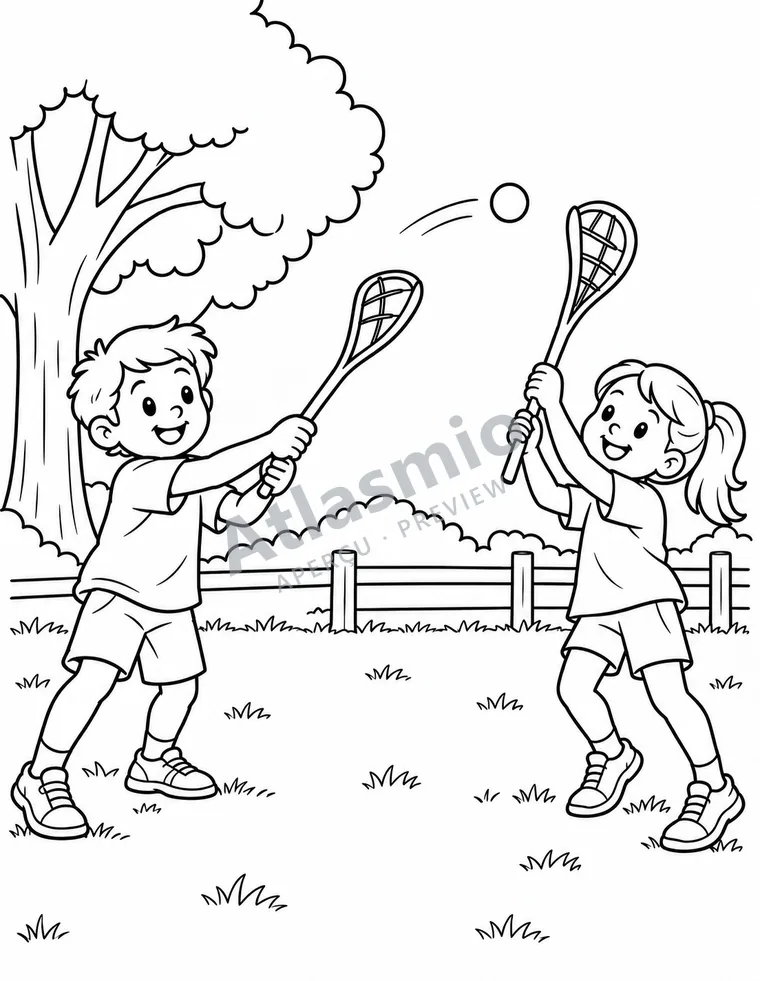
For the Haudenosaunee, lacrosse is a very old and very important game. It is also Canada’s national summer sport!
Look together
Where is the ball? Follow it with your finger.
An idea to try
Gently toss a soft ball or a pair of rolled-up socks to each other, then catch it with a basket or a box.
For the adult reading along
A little more to discover
Since 1994, a federal law has recognized lacrosse as Canada’s national summer sport and ice hockey as its national winter sport. Lacrosse is also the Creator’s Game. For the Haudenosaunee, a confederacy of six nations, it has spiritual meaning and is also a medicine game, linked to healing. In 1834, teams from Kahnawà:ke and Akwesasne played exhibition games near Montréal, and Montréal sportsmen then learned the game from their Mohawk neighbours.
Traditionally, the stick is made of hickory, a wood regarded as sacred. The drawing shows children simply playing catch, not a ceremony. Talk about fair play: passing the ball, cheering others on and thanking those who passed the game on.
Sources and context (3)
These links lead to other websites. Explore them with an adult. Source titles appear in their original language; some linked pages are in French.
- Justice Canada — National Sports of Canada Act (S.C. 1994, c. 16)Lacrosse declared the national summer sport and ice hockey the national winter sport (assented to May 12, 1994).
- The Canadian Encyclopedia — Lacrosse: From Creator’s Game to Modern SportThe Creator’s Game, spiritual for the Haudenosaunee; a medicine game; 1834 exhibition games with teams from Kahnawà:ke and Akwesasne; Montréal sportsmen learned from their Mohawk neighbours; hickory, a sacred wood.
- Haudenosaunee Nationals — Our HistoryLacrosse is one of the most revered Haudenosaunee traditions and spiritually a “medicine” game; the team represents the Six Nations Haudenosaunee Confederacy; why “Haudenosaunee” replaced “Iroquois.”
Source review: 2026-09-24. Illustrations simplify places and scenes; they are not historical documents.