

Provinces and Territories · Drawing 12 of 42
Lobster fishing
New Brunswick
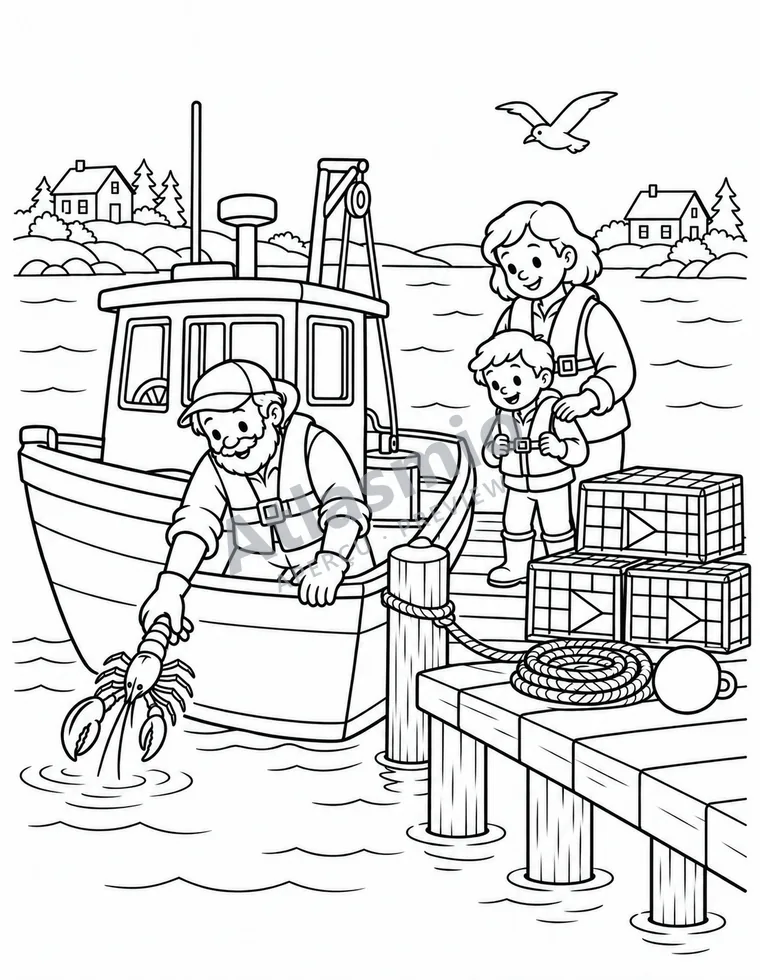
On New Brunswick’s Acadian coast, boats head out to fish for lobster. Lobsters that are too small or carrying eggs go back into the water.
Look together
How many traps can you count on the wharf?
An idea to try
Cut out paper lobsters of different sizes and a paper measuring strip. Your child puts “back into the sea” (a blue sheet) every lobster shorter than the strip.
For the adult reading along
A little more to discover
In the southern Gulf of St. Lawrence, along eastern New Brunswick, lobster is the mainstay of the fishing industry, according to Fisheries and Oceans Canada. Rules protect the resource: a minimum carapace size, the immediate release of all egg-bearing females, and traps fitted with escape vents and biodegradable panels.
After the Deportation, many Acadians settled along New Brunswick’s coasts. Look closely at the lobster’s claws, legs and antennae with your child. A live lobster is brown to olive green, sometimes flecked with red: your child can choose any colours, then compare with real life.
Sources and context (3)
These links lead to other websites. Explore them with an adult. Source titles appear in their original language; some linked pages are in French.
- Fisheries and Oceans Canada — Integrated Fisheries Management Plan: Lobster (Gulf Region)Lobster is the mainstay of the fishing industry in the Gulf Region; minimum carapace size, immediate return of all egg-bearing lobsters and of window-size females, escape vents and biodegradable panels.
- Fisheries and Oceans Canada — American Lobster (species profile)Shell brown to olive green, may be flecked with red, orange or black; five pairs of legs including the great claws; two pairs of antennae; largest Canadian populations around Nova Scotia and the southern Gulf of St. Lawrence.
- Société Nationale de l’Acadie — L’Acadie (in French)After the Deportation, many Acadians settled along the coasts of eastern and northern New Brunswick.
Source review: 2026-09-24. Illustrations simplify places and scenes; they are not historical documents.