

Canadian history · Drawing 35 of 37
The birth of Nunavut
April 1, 1999
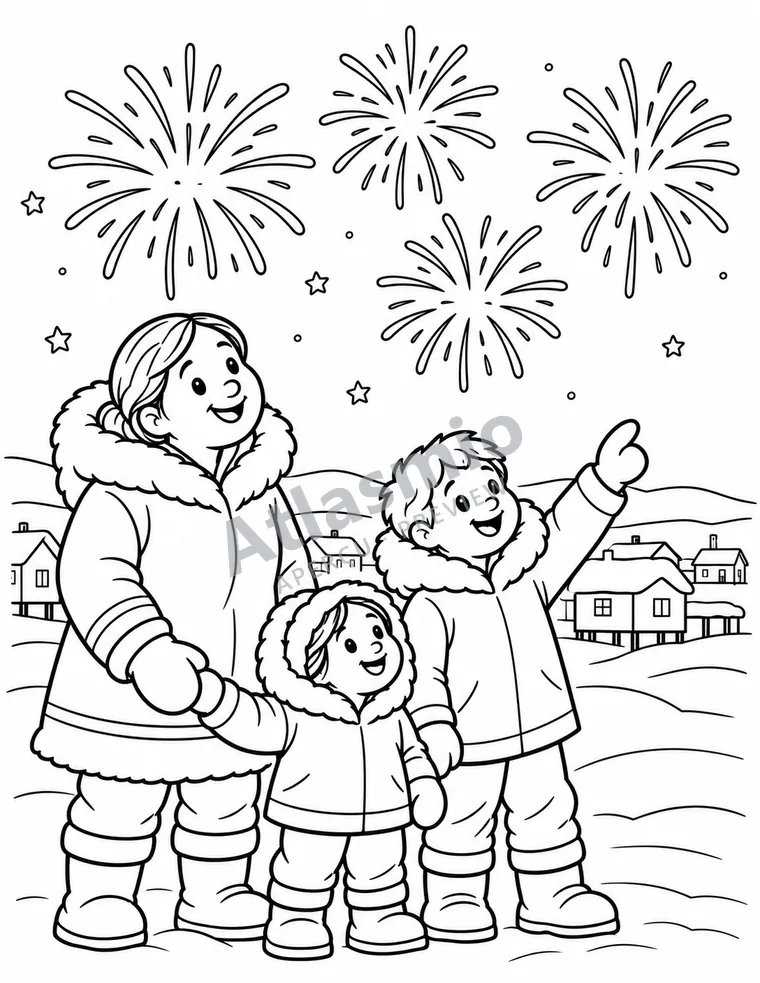
On April 1, 1999, after many years of work by Inuit, Nunavut became a new territory of Canada. In Inuktitut, its name means “our land.”
Look together
What is lighting up the sky over Iqaluit?
An idea to try
Find Nunavut and Iqaluit together on a map of Canada, then say “Nunavut” out loud along with its meaning, “our land.”
For the adult reading along
A little more to discover
Inuit Tapirisat of Canada proposed a Nunavut territory as early as 1976. In November 1992, the Inuit of Nunavut ratified the Nunavut Land Claims Agreement, which was signed in Iqaluit on May 25, 1993. Under this agreement, Inuit exchanged Aboriginal title to their traditional lands for defined rights and benefits; Nunavut Tunngavik Incorporated works to make sure governments keep these promises. On April 1, 1999, the territory came into being: fireworks lit up Iqaluit, the new legislature first sat in a high school gym, and celebrations took place across the territory.
With your child, talk about the meaning of the name “Nunavut.” Explain that Inuit were already living on these lands: in 1999, it was the map of Canada that changed.
Sources and context (3)
These links lead to other websites. Explore them with an adult. Source titles appear in their original language; some linked pages are in French.
- Legislative Assembly of Nunavut — Frequently Asked QuestionsInuit Tapirisat of Canada formally proposed a Nunavut Territory three years after 1973; Inuit ratified the Agreement in November 1992; signed in Iqaluit on May 25, 1993; territory created on April 1, 1999; Nunavut means “our land” in Inuktitut; the map of Canada was redrawn.
- Nunavut Tunngavik Incorporated — About NTINTI ensures that promises made under the Nunavut Agreement are carried out; Inuit exchanged Aboriginal title to all their traditional land in the Nunavut Settlement Area for the Agreement’s rights and benefits.
- Nunatsiaq News — Yesterday’s News: Fireworks, festivities marked the creation of Nunavut in 1999Fireworks over Iqaluit on April 1, 1999, one of many celebrations across the new territory; the legislature’s first sitting held in the gym at Inuksuk High School.
Source review: 2026-09-24. Illustrations simplify places and scenes; they are not historical documents.