

Canadian history · Drawing 33 of 37
Canada in space
1981 and 1992
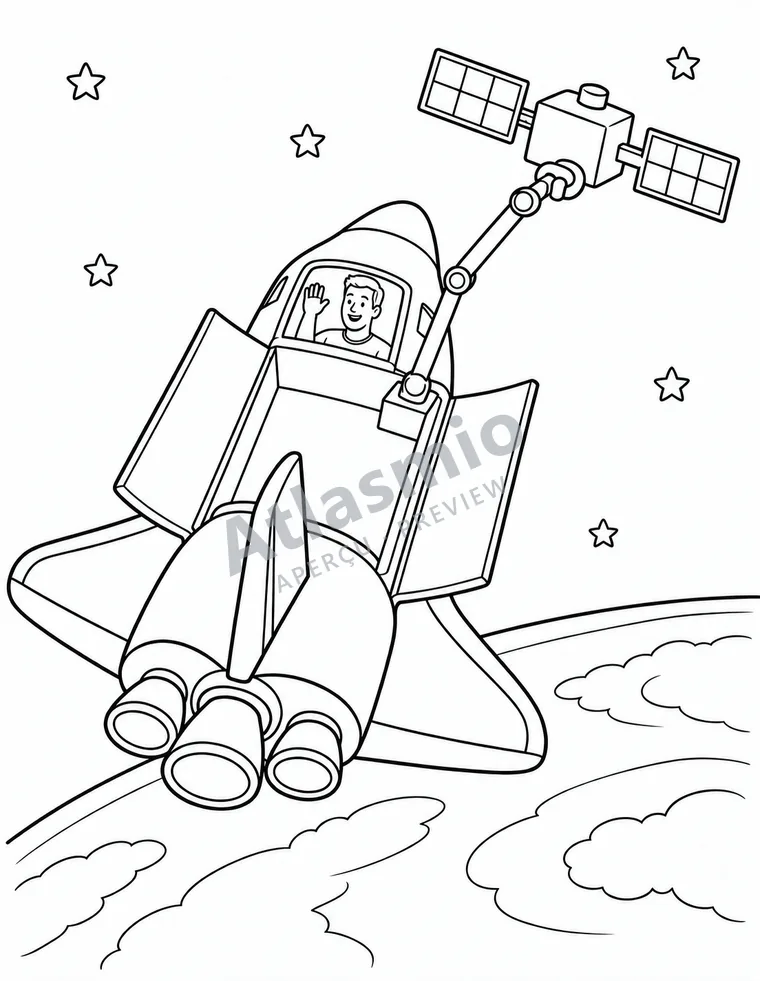
In 1981, the Canadarm, a robotic arm made in Canada, worked in space for the first time. In 1992, Roberta Bondar became the first Canadian woman to go to space.
Look together
Can you find the robotic arm’s elbow?
An idea to try
With an adult’s help, join three cardboard strips with tape to make a shoulder, an elbow and a wrist, then try to lift a scrunched-up paper ball.
For the adult reading along
A little more to discover
Canadarm was Canada’s contribution to the U.S. space shuttle program, and several Canadian companies took part in the project. It was first deployed in space on November 13, 1981, during Space Shuttle Columbia’s STS-2 mission. With joints at the shoulder, elbow and wrist, it put satellites into orbit, caught satellites for repair and helped assemble the International Space Station, making 90 flights before the shuttles retired in 2011. Canada’s contribution also opened the way for Canadian astronauts, beginning with Marc Garneau. In January 1992, neurologist Roberta Bondar flew aboard Space Shuttle Discovery and carried out more than 40 experiments.
Ask your child to bend their shoulder, elbow and wrist: that is how a robotic arm moves.
Sources and context (2)
These links lead to other websites. Explore them with an adult. Source titles appear in their original language; some linked pages are in French.
- Canadian Space Agency — About CanadarmCanada’s contribution to the shuttle project; several Canadian firms took part; first deployed in space on November 13, 1981 (STS-2, Columbia); shoulder, elbow and wrist joints; launched and captured satellites, helped assemble the ISS; retired in July 2011 after its 90th flight; opened the way for Marc Garneau.
- Canadian Space Agency — Astronaut Roberta Lynn Bondar’s biographyJanuary 22 to 31, 1992, Payload Specialist on STS-42 aboard Discovery; first female Canadian astronaut and world’s first neurologist in space; more than 40 experiments.
Source review: 2026-09-24. Illustrations simplify places and scenes; they are not historical documents.