

Canadian history · Drawing 28 of 37
Paddling for the centennial
1967
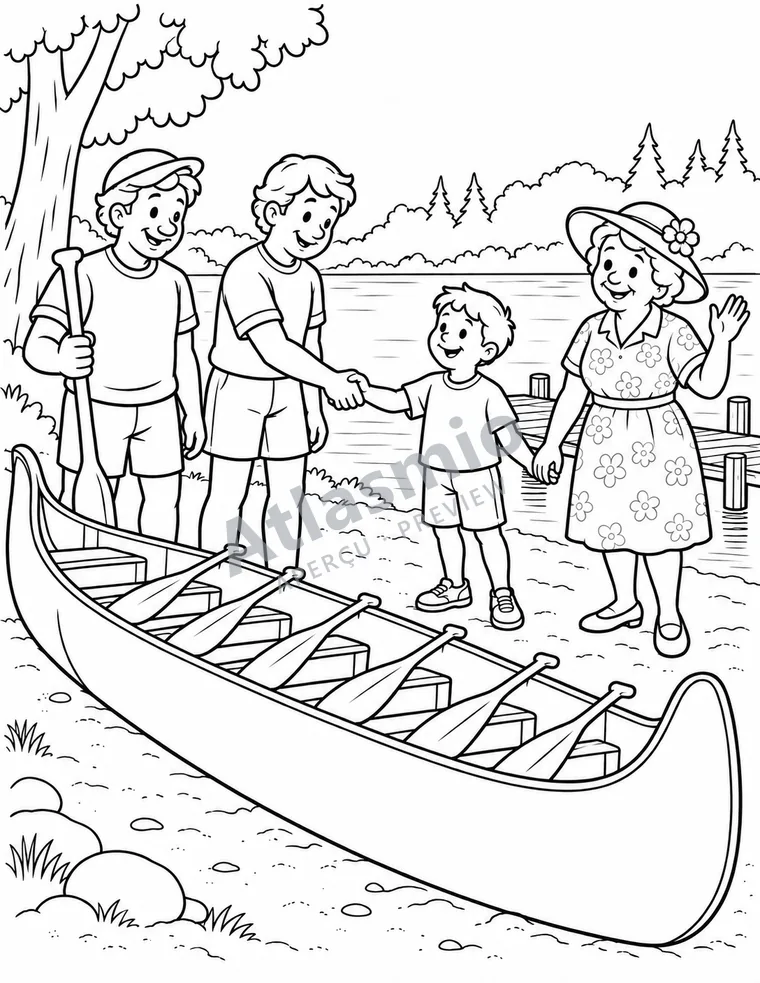
In 1967, Canada celebrated the 100th anniversary of Confederation. Ten teams of paddlers crossed much of the country by canoe, from Alberta to Expo 67 in Montréal!
Look together
How many paddles can you count in the canoe?
An idea to try
Sit one behind the other on the floor and pretend to paddle in rhythm, counting to ten together.
For the adult reading along
A little more to discover
For the centennial of Confederation, the Centennial Commission funded thousands of events across the country. On May 24, 1967, ten teams from almost every province and territory left Rocky Mountain House, Alberta, on a 104-day race that ended at Expo 67; 100 paddlers took part. Its name recalled the voyageurs of the fur trade. That same year at Expo 67, the Indians of Canada Pavilion, created by First Nations from across the country, spoke frankly about the consequences of colonial policies, including the history of Indigenous children’s education, and unsettled many visitors.
Remind your child that Indigenous peoples have lived here since long before 1867. Ask what they would like to celebrate for the 100th birthday of their school or town.
Sources and context (3)
These links lead to other websites. Explore them with an adult. Source titles appear in their original language; some linked pages are in French.
- The Canadian Encyclopedia — Canada’s Centennial Celebrations, 1967The Centennial Commission funded thousands of events; the Centennial Voyageur Canoe Pageant, a race of 100 paddlers in teams from the Rocky Mountains to Montréal.
- CBC Archives — Centennial Voyageur Canoe Pageant in 1967 launches at Rocky Mountain HouseAired May 24, 1967: ten teams of paddlers from almost every province and territory start a 104-day canoe race at Rocky Mountain House that will end at Expo 67 in Montreal.
- The Canadian Encyclopedia — Indians of Canada PavilionExpo 67 pavilion created by First Nations peoples from across Canada; uncomfortable themes about the consequences of colonial policies, including education of Indigenous children; displays shocked and unsettled visitors and the press.
Source review: 2026-09-24. Illustrations simplify places and scenes; they are not historical documents.