

Canadian history · Drawing 20 of 37
The discovery of insulin
1921–1922
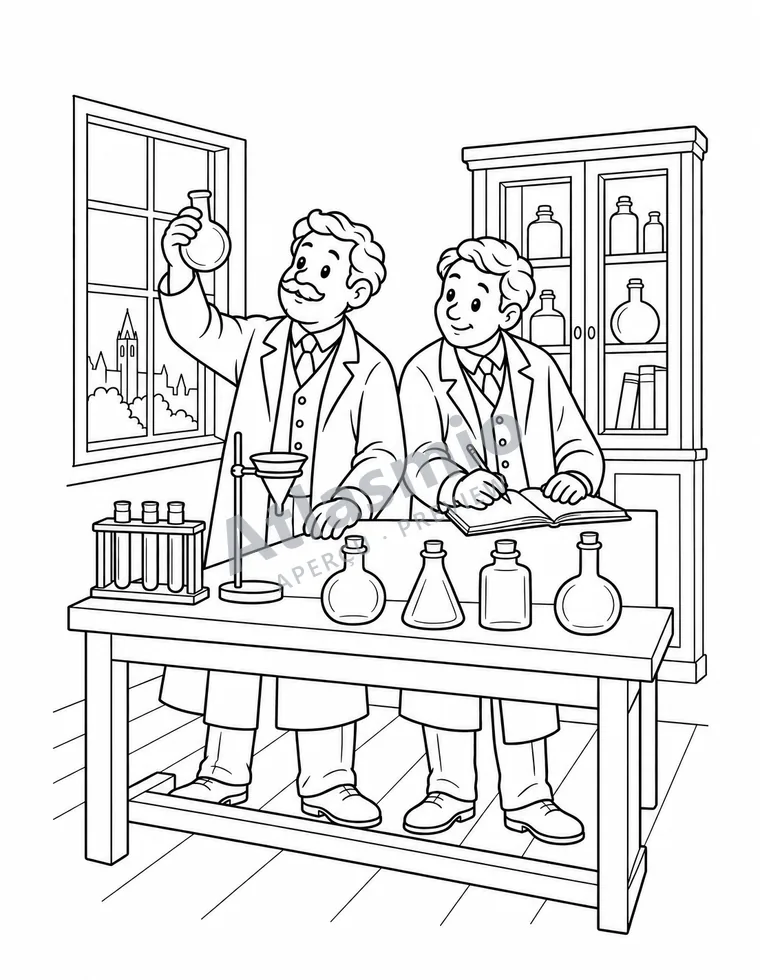
In 1921 and 1922, in Toronto, Banting, Best, Collip and Macleod discovered insulin. Today, this medicine still helps children and adults live with diabetes.
Look together
If you were a scientist, what would you like to discover?
An idea to try
For one day, keep a young scientist’s notebook: your child writes or draws a question, observes, then tells you what they found out.
For the adult reading along
A little more to discover
In May 1921, Frederick Banting and Charles Best began their experiments at the University of Toronto, in the laboratory directed by John J. R. Macleod. Biochemist James Collip joined them in December and succeeded in purifying the extract. The early research was done on dogs, a difficult part of this story. In January 1922, at Toronto General Hospital, a teenager named Leonard Thompson received the purified extract and improved dramatically. Before insulin, severe diabetes was often fatal, especially for children. In 1923, Banting and Macleod received the Nobel Prize and shared the prize money with Best and Collip, despite bitter disputes over credit.
Insulin does not cure diabetes: it lets people live with it. If your child knows someone with diabetes, welcome their questions and explain that it is an illness, not anyone’s fault.
Sources and context (3)
These links lead to other websites. Explore them with an adult. Source titles appear in their original language; some linked pages are in French.
- The Canadian Encyclopedia — The Discovery of InsulinBanting and Best began work under Macleod at the University of Toronto on 17 May 1921; Collip joined in December 1921 and purified the extract; dog experiments; Leonard Thompson treated in January 1922 at Toronto General Hospital; 1923 Nobel Prize shared with Best and Collip; disputes over credit.
- Parks Canada — Discovery of Insulin National Historic EventResearch in 1921–1922 on the University of Toronto campus by Banting, Best, Collip and Macleod; successful clinical tests in 1922; diabetes a death sentence for many, especially children; Nobel Prize money shared with Best and Collip.
- Public Health Agency of Canada — DiabetesType 1 diabetes usually develops in childhood or early adulthood; there is currently no cure for diabetes.
Source review: 2026-09-26. Illustrations simplify places and scenes; they are not historical documents.