

Canadian history · Drawing 17 of 37
A home on the Prairies
1905
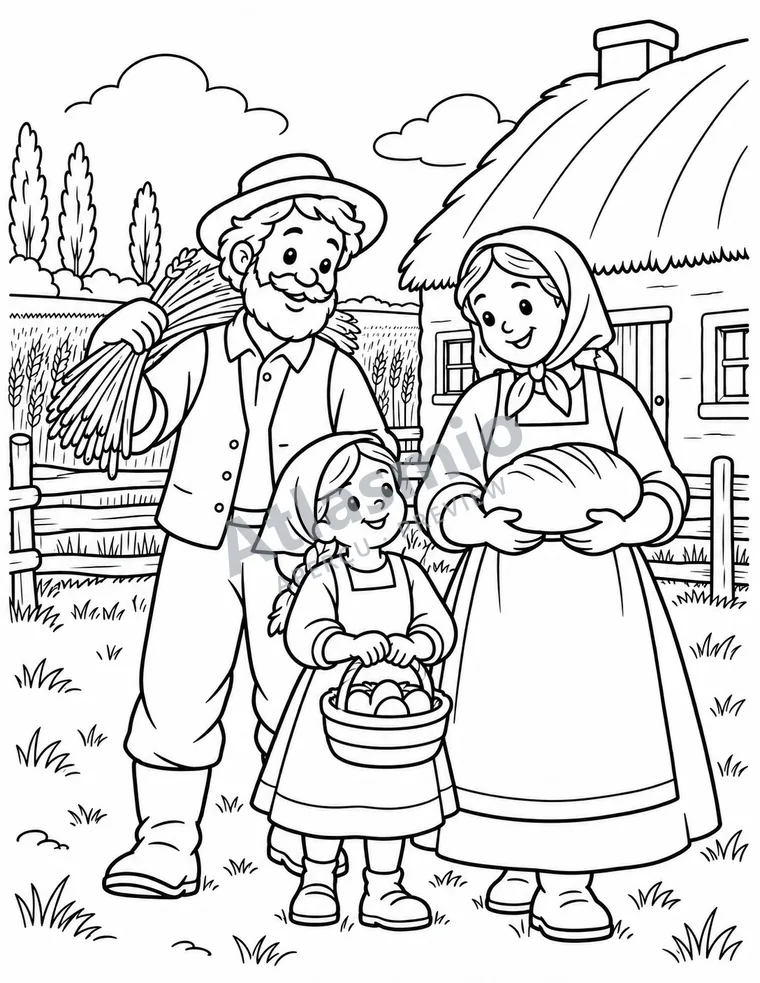
In 1905, Alberta and Saskatchewan became provinces. Many newcomers, including Ukrainian families, were building farms on the Prairies, the homelands of First Nations and Métis.
Look together
What is each person holding?
An idea to try
Draw your home and the people who live in it. Then ask an older relative to tell you about the places your family has lived.
For the adult reading along
A little more to discover
From 1896 to 1914, the federal government pursued an aggressive immigration policy, and hundreds of thousands of settlers came to the Prairies. About 170,000 Ukrainians arrived by 1914; the first permanent Ukrainian settlement was founded in 1892 at Edna-Star, near Edmonton. For a $10 fee, a settler received 65 hectares (160 acres) and had three years to build a home and start farming. The creation of Alberta and Saskatchewan on September 1, 1905, followed this immigration boom.
The land was not empty. It was the homeland of First Nations bound to the Crown by treaties, and of Métis families, many of whom lost their land through the scrip system. Ukrainians also faced injustice: during the First World War, many were interned in camps as “enemy aliens.” Talk with your child about moving: what would you bring, and who would you like to meet?
Sources and context (3)
These links lead to other websites. Explore them with an adult. Source titles appear in their original language; some linked pages are in French.
- Ukrainian Canadian Congress — Ukrainian Immigration to Canada – Early Years (PDF)Wasyl Eleniak and Ivan Pylypiw arrived in 1891; first permanent Ukrainian settlement founded in 1892 at Edna-Star, near Edmonton; mass immigration from 1896; 170,000 Ukrainians by 1914; internment as “Enemy Aliens” in camps until 1920.
- The Canadian Encyclopedia — AlbertaImmigration boom of 1896–1914 and the federal government’s aggressive immigration policy under Clifford Sifton; creation of Alberta on 1 September 1905 as the result of the boom; Treaties 6, 7 and 8.
- The Canadian Encyclopedia — Dominion Lands Act$10 fee and three years to build a habitable residence and cultivate; 65-hectare quarter-sections; hundreds of thousands of settlers; Indigenous inhabitants not consulted; numbered treaties; Métis scrip used to remove Métis title and make way for White settlers.
Source review: 2026-09-24. Illustrations simplify places and scenes; they are not historical documents.